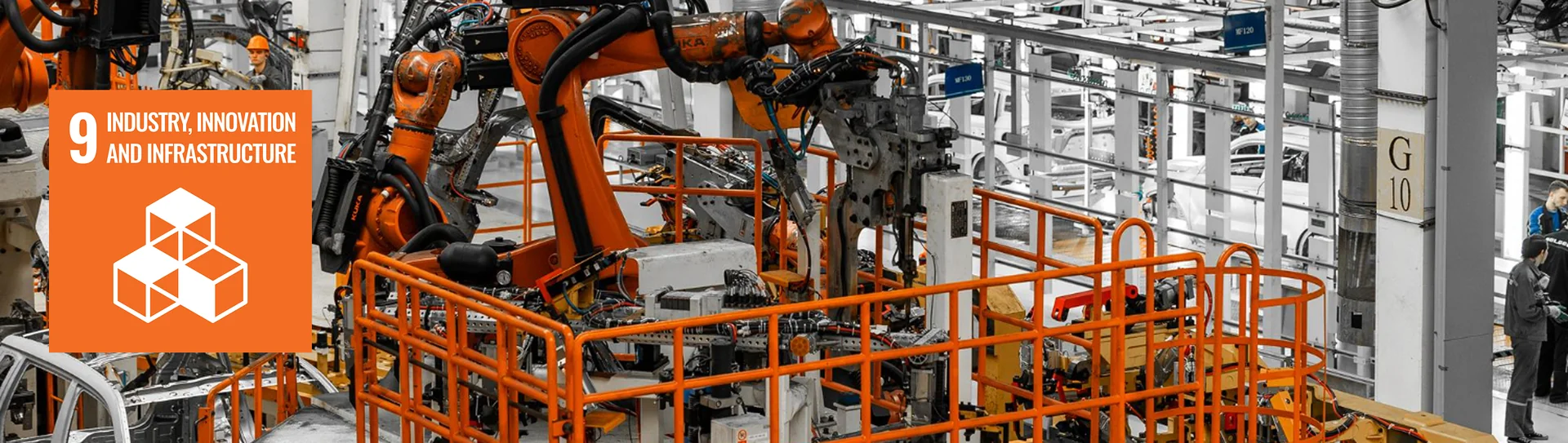
The UN Sustainable Development Goal 9 focuses on building resilient infrastructure, promoting inclusive and sustainable industrialisation, and fostering innovation. SDG 9 has 8 goals that help people all over the world work together to develop physical infrastructure, make it easier for people to acquire financial services, promote small businesses, boost scientific research, and speed up the use of clean, sustainable technologies. The goal has 12 indicators for keeping track of success. These include important criteria including the quality of infrastructure, the value generated by industry, the intensity of carbon emissions, research and development spending, and access to information and communication technologies. Together, these targets and indicators offer a roadmap for transforming how economies grow. They push for smarter systems, from transportation and energy to digital connectivity and industrial development, that are environmentally sound, economically inclusive, and innovation-driven.
Targets | Indicators |
|---|---|
| 9.1 Build quality, reliable, and sustainable infrastructure across regions and borders to support economic growth and improve people’s well-being. A special focus should be on making infrastructure affordable and accessible to everyone. | 9.1.1 Percentage of rural people living within 2 km of a road that can be used all year round. 9.1.2 Amount of passengers and goods transported, categorized by type of transport (e.g., road, rail, air, sea). |
| 9.2 Advance inclusive and sustainable industrial development. Aim to raise industry’s contribution to employment and GDP by 2030, especially in least developed countries. | 9.2.1 How much manufacturing helps the economy and each person. 9.2.2 How many people work in manufacturing compared to the total workforce. |
| 9.3 Help small businesses, especially in developing areas, get better access to financial services like affordable loans, and connect them to bigger markets and supply chains. | 9.3.1 The percentage of small businesses in the whole industrial economy. 9.3.2 Percentage of small businesses that have access to a loan or line of credit. |
| 9.4 Make factories and other buildings more environmentally friendly by 2030. Use resources more wisely and switch to cleaner technologies, depending on what each country can do. | 9.4.1 The amount of material each individual uses and the amount of GDP. 9.4.2 Amount of CO₂ emissions for every unit of economic output from industry. |
| 9.5 Help scientists do their work and make technology better in businesses, especially in developing countries. By 2030, there should be more innovation, more money spent on research and development, and more researchers for every million people. | 9.5.1 Spending on research and development as a percentage of the country’s GDP. 9.5.2 Number of full-time researchers per million people. |
| 9.a Increased financial and technical assistance can help developing nations particularly those in Africa, landlocked countries, and small islands, build robust, long-lasting infrastructure. | 9.a.1 Amount of international aid given to infrastructure projects |
| 9.b Make policies that help industries grow and add more value to their products to encourage technology, research, and innovation in developing countries. | 9.b.1 Share of total industrial output that comes from medium and high-tech industries. |
| 9.c Ensure safe and fair workplaces for all workers, especially migrant and vulnerable workers. | 9.c.1 Make digital technology much easier to get and work toward making the internet available to everyone at a low cost in the world's poorest countries, especially through mobile networks. |

Several significant challenges hinder the achievement of Sustainable Development Goal 9, which focuses on developing robust infrastructure, promoting inclusive industrial growth, and fostering innovation.
About 3 billion people still don't have access to the internet. They can't use digital tools, get services, or share new ideas very well without the internet. A lot of communities also don't have the basics, like reliable roads, electricity, and broadband. Small businesses in developing countries have a hard time getting the money they need to build or keep up these important systems.
Additionally, weak industrial ecosystems pose a significant problem. Because of the COVID-19 pandemic, rising energy costs, and broken supply chains, manufacturing has slowed down in many places. Simultaneously, high costs and a lack of skilled workers, particularly in poorer countries, are increasing the urgent need to transition to smart buying and green infrastructure.
Innovation is also not even. Only a few countries are at the top when it comes to research and digital development. The rest of the world struggles to generate new ideas and adopt new technologies.
To truly achieve SDG 8, the path forward must go beyond recovery; it must be transformational. It’s about building economies where everyone has a fair income, where work is dignified, and where no one is left behind. That’s the future we should be working towards.

There are still people who are not online. We need to put money into cheap, fast internet to close this gap, especially in rural and underserved areas. Universal digital access is necessary for participating in the modern economy, coming up with new ideas, and e-governance.

Many places still don't have necessities like roads, electricity, and water. Investments in infrastructure must be low-carbon and able to withstand climate change and natural disasters. This can be done by using renewable energy, eco-friendly materials, and designs that can withstand these changes.

Small and medium-sized businesses (SMEs) are important for creating jobs and new ideas in their communities, but they often don't have access to money and technology. Governments and banks need to give out loans, grants, and tech support, especially in developing countries.

Innovation is currently concentrated in a few developed countries. To balance this, we need to decentralize research and development by supporting innovation hubs, incubators, and research centers in low- and middle-income regions.

A skilled workforce is important for the future of business. We need to expand training programs in areas like digital literacy, engineering, data science, and green technologies, with a focus on young people, women, and people from marginalized communities.

Industry and infrastructure depend on reliable energy sources. Increasing access to clean, cheap, and stable energy sources, especially in areas that don't have a lot of energy, will boost the economy and lessen its effects on the environment.

COVID-19 and other shocks around the world have shown how weak supply chains can be. To make their industrial systems stronger, countries need to get supplies from more than one place, encourage local manufacturing, and put money into digital supply chain management.

Governments alone cannot fund or manage infrastructure and industrial growth. PPPs can leverage private sector expertise and capital, especially for large-scale transport, energy, and telecom projects.

Industries need to cut down on waste and emissions. Governments can push this along by giving companies tax breaks, encouraging them to buy green products, and giving them incentives to use cleaner technologies, make things in a circular way, and run their businesses without adding to the carbon footprint.

Progress on SDG 9 requires collaboration across borders. Developed countries must share technologies, offer technical assistance, and support trade policies that allow developing countries to scale industrial growth sustainably.
To reach Sustainable Development Goal 9—governments, the private sector, civil society, and international partners, must work together and share responsibility. Governments are important because they make the right policies, put money into public infrastructure, support research and development, and make rules that promote growth that is low in carbon and open to everyone. However, the public sector alone cannot achieve these goals.
The private sector is also equally important for coming up with new ideas, paying for new technologies, and growing the capacity of industries.
To meet their sustainability goals, businesses need to invest in clean technologies, help local businesses improve supply chains, and work with the government in public-private partnerships that benefit both business and society.
Simultaneously, schools and research centres must contribute to this progress by providing education and generating innovative ideas.
They help build a skilled workforce and close the gap between knowledge and action by supporting science and technology education, doing research that is relevant to the situation, and working with business and government.
Additionally, civil society organizations ensure that this progress is inclusive and accountable. They amplify the voices of vulnerable communities, advocate for equitable access to infrastructure and services, and monitor the environmental and social impacts of development.
Their grassroots engagement ensures that no one falls behind in the pursuit of industrial progress. Lastly, countries with a lot of money and international organizations need to work together to help developing areas build their capacity and find long-term solutions. They can do this by sharing technology, money, and knowledge.
These people work together to create an ecosystem of shared responsibility. We can only build the infrastructure, industries, and new ideas we need for a future that is sustainable, inclusive, and strong for everyone by working together.

Abhigyan Gupta
Advance your strategy with solutions calibrated to your market environment.
SDG 9 is to “build resilient infrastructure, promote inclusive and sustainable industrialization, and foster innovation.” It emphasizes strengthening the foundations of economic growth while ensuring sustainability, equity, and innovation.
SDG 9 is important because infrastructure connects people to essential services, industries create jobs and reduce poverty, and innovation drives solutions for global challenges like climate change. Without progress here, achieving other SDGs becomes much harder.
This goal can be achieved by creating resilient infrastructure that can withstand future challenges, developing industries that are environmentally sustainable, and fostering innovation through education, research, and technology-driven solutions.
Industry refers to economic activities that create jobs and growth, innovation is the process of developing new ideas and technologies, and infrastructure is the system of transport, energy, water, and digital networks that support societies and economies.
If this goal is not achieved, economies risk stagnation, inequality will deepen, and societies will be less resilient to crises. Innovation will slow, making it harder to address urgent issues like climate change, poverty, and global health challenges.