
The urgency behind marine farming innovation is grounded in hard numbers. Global fish consumption has more than doubled since the 1960s, and the Food and Agriculture Organization of the United Nations (FAO) estimates that over 35% of global fish stocks are now fished at biologically unsustainable levels. Simultaneously, as stated by the Environmental Protection Agency (EPA), ocean surface temperatures have risen by approximately 0.13°F per decade from 1901 to 2015, bleaching coral reefs, disrupting migration patterns, and collapsing the food chains that underpin ocean biodiversity. The consequences are not purely ecological. The blue economy, a suite of ocean-based industries including fisheries, tourism, shipping, and energy, contributes an estimated $2.5 trillion to the global economy annually, according to the World Economic Forum. When marine ecosystems degrade, that value evaporates. Coastal communities dependent on sustainable fisheries lose livelihoods; nations dependent on seafood for protein security face a nutritional crisis. What regenerative ocean farming proposes, then, is not a conservation measure but a structural shift, one that asks whether the ocean can be farmed in a way that makes it more productive and more resilient at the same time. The answer, increasingly, appears to be yes.
The term "regenerative" is sometimes used loosely, but in the context of marine aquaculture, it carries a precise meaning: farming practices that leave the surrounding ecosystem in better condition than they found it. This is achieved through a combination of ecological design principles.

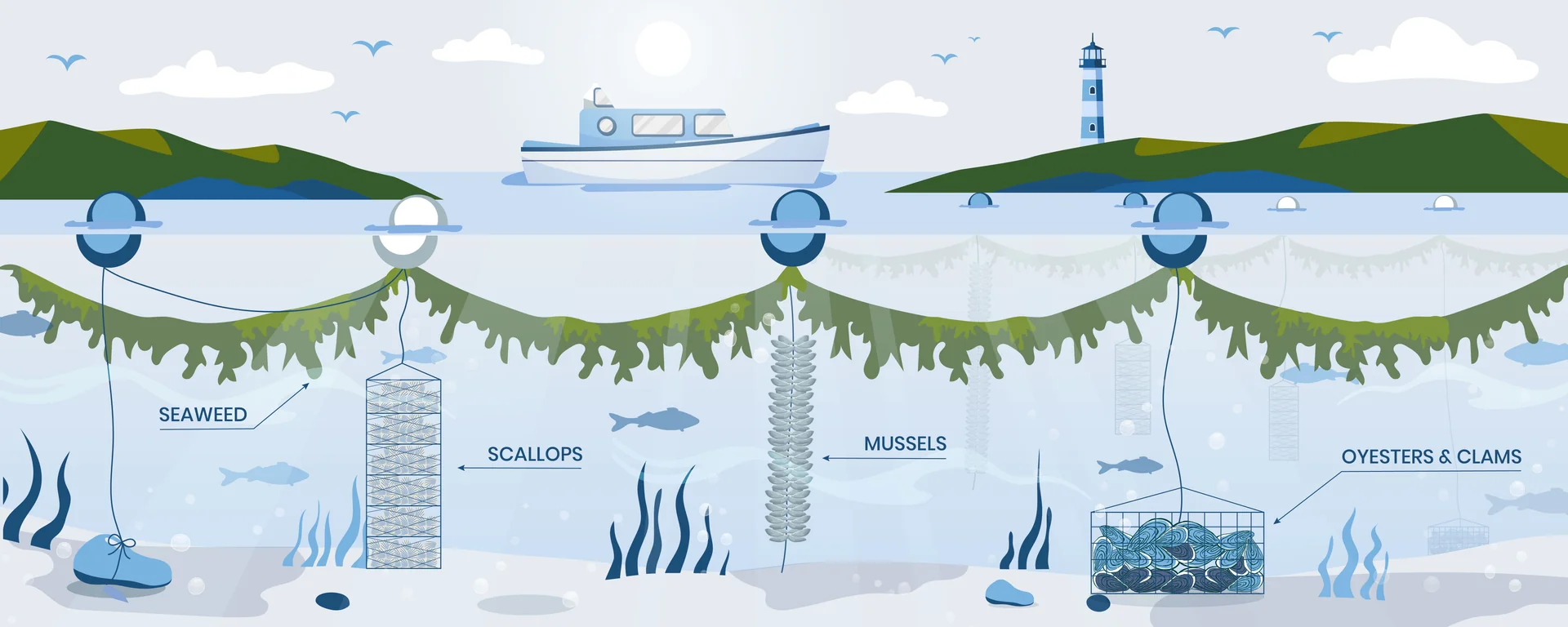
The most widely cited model is the “3D ocean farm,” developed by fisherman-turned-farmer Bren Smith and popularised through GreenWave. In a 3D farm, vertical lines hang from buoys anchored to the seabed. Kelp and other seaweeds grow along the upper lines, mussels and oysters are suspended in nets at mid-water depth, and scallops and clams are placed in cages near the bottom. No feed pellets. No freshwater abstraction. No land clearance. No synthetic fertiliser runoff. The polyculture design ensures that species do not compete; they complement one another. The environmental side of the ledger is equally compelling. Dense kelp farming zones create underwater forests that provide habitat for hundreds of marine species, oxygenate surrounding waters, and absorb excess nutrients from agricultural runoff. Seaweed absorbs dissolved CO₂ and can reduce local ocean acidity, creating more favourable chemical conditions for the shellfish growing beneath it. Shellfish, in turn, filter substantial volumes of water; a single adult oyster can filter up to 190 litres per day. Kelp and shellfish together remove nitrogen and phosphorus, the nutrients responsible for algal blooms and dead zones, at measurable rates. A well-managed farm functions, in effect, as a small piece of working infrastructure for the ocean itself.

Perhaps the most ecologically potent component of regenerative systems is seaweed. Seaweed cultivation has expanded rapidly; global production now exceeds 35 million tons annually, with the Asia-Pacific region accounting for the vast majority, as per FAO. But the ecological role of seaweed goes far beyond food production. Seaweed also plays a pivotal role in climate mitigation through its capacity for carbon sequestration. Research cited in the National Library of Medicine states that natural seaweed ecosystems may sequester between 61 and 268 million tons of carbon per year globally, with an average of 173 megatons. The wide range reflects a genuine scientific debate: not all seaweed carbon sinks to the ocean floor and stays there; much of it is remineralized and re-released, meaning the net climate benefit depends heavily on where farms are located and how biomass is managed. That uncertainty has not dampened investment interest; it has redirected it toward solving the measurement problem, which is itself now an active area of ocean science and carbon market development. Deliberate seaweed farming at scale, if paired with robust carbon accounting, could still represent one of the more scalable natural climate solutions available.
Blue carbon, the carbon stored in coastal and ocean ecosystems, has become one of the most compelling arguments for investing in regenerative marine practices. Mangroves, seagrasses, and tidal marshes can sequester and store significantly more carbon per unit area than terrestrial forests, according to research cited in Frontiers in Ecology and the Environment. Yet these ecosystems are disappearing at alarming rates: mangroves alone are lost at an estimated 0.3–0.6% per year in recent decades, as per the Earth.Org. Integrating blue carbon accounting into regenerative aquaculture frameworks creates a dual opportunity: farms generate revenue from food sales while also potentially qualifying for carbon credits. The catch, and it is a meaningful one, is that blue carbon measurement methodology is still maturing. Unlike forestry carbon credits, where satellite imaging and ground-truthing have become relatively standardized, marine carbon accounting must contend with dynamic tidal systems, variable sediment conditions, and species-specific carbon retention rates. Several programmes are already navigating this complexity. In Australia, blue carbon methodology has been formally incorporated into the national Emissions Reduction Fund. In the United States, GreenWave has collaborated with environmental organizations to develop a seaweed-specific carbon credit protocol. The science and the market are converging, but the credibility of blue carbon as a revenue stream will ultimately depend on solving the measurement problem, not just declaring the opportunity. That is precisely why this moment matters. As carbon markets mature and measurement frameworks improve, first movers who have already built verified ocean restoration projects will be positioned to monetize carbon outcomes that latecomers cannot yet credibly claim.
Regenerative ocean farming is not only a climate solution; it is also a profound reimagining of how humanity feeds itself. The world's sustainable food systems conversation has long been dominated by land-based agriculture, but the ocean represents a vastly underutilized frontier. The High Level Panel for a Sustainable Ocean Economy estimates that sustainably managed oceans could supply up to six times more food than they do today, not through intensification, but through expanding the range of species farmed, reducing post-harvest waste, and unlocking the productive potential of coastal and open-ocean environments that are currently untouched by cultivation. The nutritional value of ocean-farmed species is real, but the more compelling argument for a sustainability audience is one of footprint. According to the National Library of Medicine, producing a kilogram of mussels generates around 0.6 kg of CO₂e, compared to 19-36.7 kg for beef (roughly 95-98% fewer greenhouse gas emissions than beef), requires no arable land, and consumes no freshwater. Seaweeds such as dulse and kelp need no soil, no irrigation, and no fertilizer. They are, in a very literal sense, the least resource-intensive foods that can be grown at scale. In a world where agriculture currently occupies half of the planet's habitable land, that distinction is not a detail; it is the entire argument.
It is important not to conflate regenerative ocean farming with conventional sustainable aquaculture. While standard aquaculture can reduce pressure on wild fisheries, it is often associated with environmental costs of its own: dense salmon pens that generate sea-lice infestations, shrimp farms that displace mangroves, and tilapia operations that rely heavily on wild-caught forage fish for feed. The industry has grown rapidly, but growth alone has not resolved its ecological debts. Regenerative systems are explicitly designed to avoid these pitfalls by working with, rather than against, natural ecological processes. That distinction is what makes their capacity for genuine ecosystem restoration, as opposed to mere damage reduction, so significant.
The ability to restore degraded marine ecosystems is perhaps the most striking quality of regenerative ocean farms. Studies of oyster reef restoration along the U.S. Atlantic coast have demonstrated measurable improvements in local fish populations, sediment quality, and water clarity within just a few years of reintroduction, as stated in The Nature Conservancy. The mechanism is straightforward: a single adult oyster can filter up to 50 gallons of water per day, removing nitrogen, phosphorus, and suspended particles that would otherwise fuel harmful algal blooms. This regenerative capacity extends to kelp forests. Where kelp has been lost, often due to sea urchin overpopulation following the decline of their natural predators, strategic kelp reseeding can cascade through entire food webs, returning biodiversity to previously barren seafloors. It is one of ecology's more arresting demonstrations of trophic logic: restore one layer of the system, and the rest begins to reassemble around it. The Kelp Forest Alliance is coordinating international efforts to protect and restore kelp ecosystems globally, recognizing that kelp restoration functions simultaneously as ocean agriculture, habitat creation, and carbon drawdown. The scale of what is ecologically possible, however, runs well ahead of what current policy, investment, and coordination frameworks can support.
Despite its promise, scaling ocean sustainability-focused farming faces significant barriers. These fall into three broad categories:
Cost structure
The structural advantages are real—no feed, no freshwater, low energy. The main capital expenditure is rope, anchors, and buoys; the main operating expenditure is labour, boat time, and post-harvest processing. Farms can be productive within 18 to 24 months.
Revenue diversification
A farmer growing sugar kelp, mussels, scallops, and oysters simultaneously is selling into four largely uncorrelated markets. One weak season in scallops does not sink the operation, a meaningfully different risk profile from a salmon pen or a monoculture crop.
Honest constraints
Permitting alone can outlast construction in many jurisdictions. Processing infrastructure for seaweed remains thin outside Asia, pushing farmers toward low-margin commodity sales. Insurance is still standardising, and the sector has yet to prove it can scale without repeating the crowding, disease, and genetic narrowing it was built to avoid.
Realistic investors treat this as an infrastructure build-out, not a commodity trade. The capital that wins here will be patient, thesis-driven, and willing to underwrite permitting and midstream assets alongside the farms themselves.
In a sector where impact verification is constantly non-negotiable for investors and regulators, Cognitud plays a significant part in it. Watch out for the integration of regenerative ocean farming into climate and biodiversity disclosure frameworks — TNFD, the ISSB, the EU Taxonomy — as a qualifying activity thereby unlocking cheaper capital and broadening the eligible investor base. Our ESG consultants help sustainability-focused organizations, including those operating across the blue economy, measure, manage, and communicate environmental and social outcomes with precision. For regenerative ocean farmers seeking to access carbon markets or attract ESG capital, credible and standardized impact data is the difference between being fundable and being overlooked. Cognitud bridges the gap between the ecological work happening on the water and the financial systems that need to evaluate it, making it easier for the investors to back ocean agriculture with confidence and for farmers to build the credibility that unlocks capital at scale.


Dr. Somnath Hazra
Build actionable plans grounded in your sector’s risks and growth priorities.
Regenerative ocean farming refers to aquaculture practices designed to leave marine ecosystems in better condition than before. It integrates species like seaweed and shellfish in systems that mimic natural ecosystems, producing food while restoring water quality, biodiversity, and overall ocean health.
Regenerative ocean farming is carried out by designing multi-species systems—such as 3D ocean farms—where seaweed grows on surface lines, shellfish are suspended in the water column, and other species are cultivated below. These systems rely on natural ocean nutrients, requiring no feed, freshwater, or fertilizers.
Regenerative farming is not necessarily the same as organic farming. While both avoid harmful inputs, regenerative farming focuses specifically on restoring ecosystems and improving environmental conditions, rather than strictly adhering to organic certification standards.
Marine ecosystems are interconnected ocean environments that include habitats like coral reefs, mangroves, seagrasses, and kelp forests. These systems support marine biodiversity, regulate water quality, and sustain the food chains that underpin ocean life.
The blue economy refers to ocean-based industries such as fisheries, tourism, shipping, and energy that collectively contribute trillions of dollars to the global economy. It emphasizes the sustainable use of ocean resources to support economic growth, livelihoods, and ecosystem health.