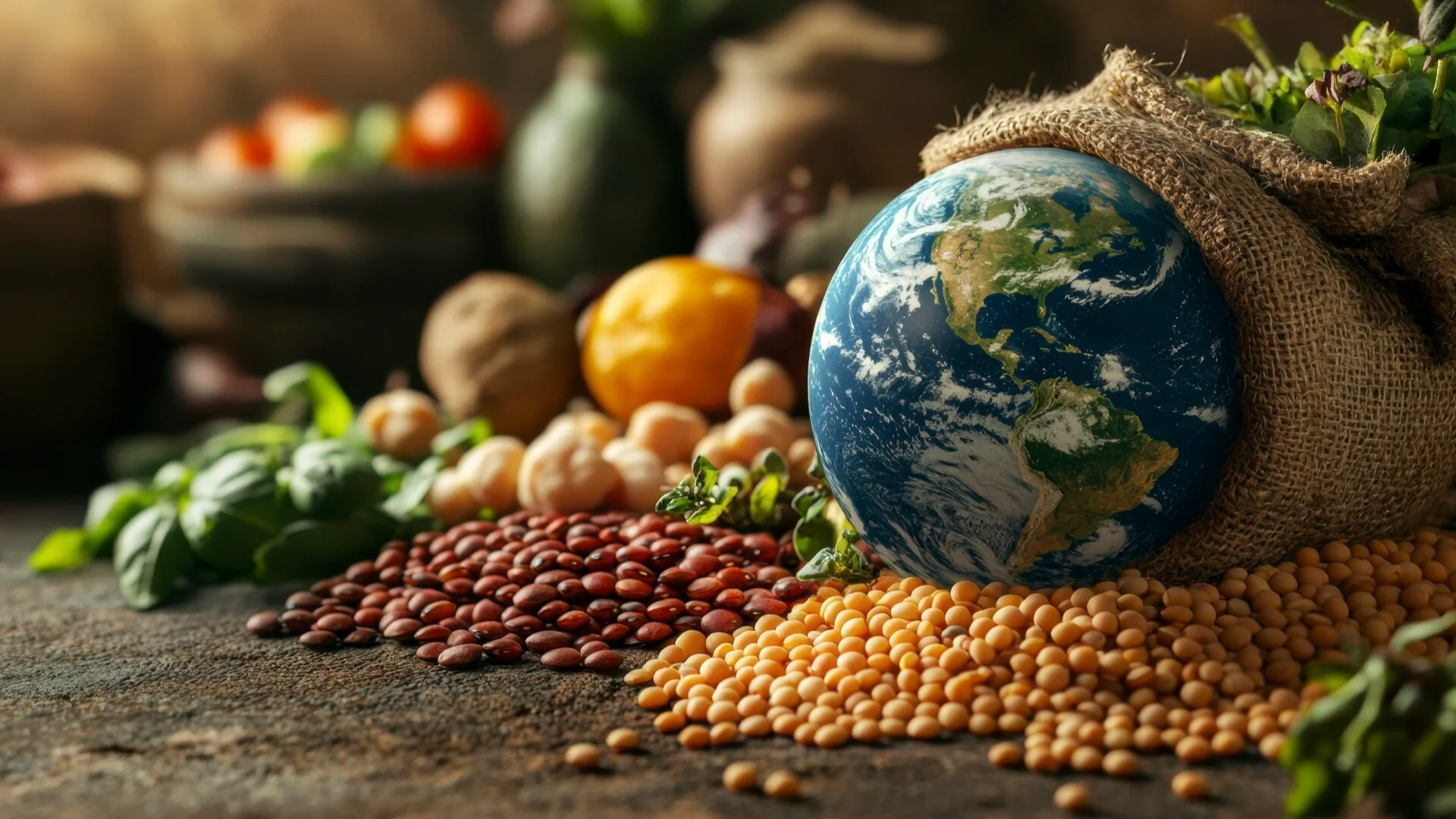
The report begins with a simple yet important reminder: land and water resources are finite, and once degraded, recovering them becomes difficult, slow, and expensive. Despite decades of advancement in agriculture, the world is experiencing: • accelerating land degradation, • shrinking freshwater supplies, and • mounting climate-related disruptions. In 2024 alone, around 673 million people faced hunger. As populations grow and consumption patterns evolve, demand for food, feed, fibre and freshwater will only increase. Yet agricultural land is not expanding. In fact, FAO states that more than 60% of human-induced land degradation happens on agricultural land itself, meaning the very places meant to grow food are losing productivity year after year.
FAO makes a clear point: by 2050, farming must produce 50% more food than in 2012 and use 25% more freshwater, all without expanding into forests, wetlands, or other fragile ecosystems. The traditional model of clearing more land is no longer viable. Doing so would accelerate biodiversity loss, worsen climate change, and weaken the very ecological systems that agriculture relies on. The report calls for a shift toward smarter, more efficient production, making better use of the land and water we already have.
Despite the seriousness of the situation, SOLAW 2025 is not a pessimistic document. In fact, it highlights a powerful truth that the world still has enormous untapped potential if we use our land and water wisely. The report lays out practical, achievable opportunities to boost food production without harming ecosystems. One of the biggest opportunities lies in 𝗰𝗹𝗼𝘀𝗶𝗻𝗴 𝘁𝗵𝗲 𝘆𝗶𝗲𝗹𝗱 𝗴𝗮𝗽. In many developing regions, crops grow far below their potential. For instance, rainfed farms in sub-Saharan Africa achieve only about 24% of their potential yields. With better soil care, stronger seeds, and modern agronomic practices, productivity could rise significantly and sustainably. FAO also emphasizes the need to strengthen 𝗿𝗮𝗶𝗻𝗳𝗲𝗱 𝗮𝗴𝗿𝗶𝗰𝘂𝗹𝘁𝘂𝗿𝗲, which supports millions of smallholder farmers. Practical and accessible methods like conservation agriculture, drought-resistant crop varieties, moisture-retention techniques, organic composting, and crop diversification can help farmers withstand climate shocks, enrich soil health, and improve yields even under unpredictable weather patterns. 𝗜𝗻𝘁𝗲𝗴𝗿𝗮𝘁𝗲𝗱 𝗳𝗮𝗿𝗺𝗶𝗻𝗴 systems present another major opportunity. Approaches like agroforestry, rotational grazing, forage improvement, and rice–fish farming blend crops, livestock, and natural cycles to build long-term resilience. These systems promote healthier soils, greater biodiversity, and more stable food production over time. However, FAO makes it clear that technology alone cannot solve these challenges. Sustainable progress requires: • strong institutions, • coherent and enforceable policies, • access to reliable environmental data, • sustainable financing, and • capacity-building at both community and national levels. There is no “one-size-fits-all” model. Each region needs solutions tailored to its land, soil, climate, and water context.
SOLAW 2025 offers a hopeful reminder amid the warnings: the world still has the capacity to feed up to 10.3 billion people by 2085, when global population is expected to peak. But turning that potential into reality depends on the choices made today, especially how we protect and manage land and water. As FAO Director-General QU Dongyu says, “The choices we make now will determine how we meet future demands while protecting the world for generations to come.”
Cognitud helps turn the ambitions of FAO’s SOLAW 2025 report into real-world action by bringing together science, technology, and community-driven solutions. We empower governments, agribusinesses, and institutions to close yield gaps, restore degraded ecosystems, and build climate-resilient food systems through advanced land and water assessments, regenerative agriculture strategies, nature-based interventions, and strong ESG and policy frameworks. By aligning sustainability with practical implementation and investment readiness, Cognitud enables stakeholders to protect the resources that feed us while securing a more resilient future for generations to come.


Dr. Somnath Hazra
Build actionable plans grounded in your sector’s risks and growth priorities.
Soil health can be improved through practices such as cover cropping, reduced tillage, composting, crop rotation, agroforestry, integrated nutrient management, and minimizing chemical overuse. These methods restore organic matter, enhance biodiversity, and strengthen soil structure.
Land degradation is caused by deforestation, overgrazing, unsustainable farming practices, soil erosion, pollution, climate change, water mismanagement, and urban expansion. These pressures reduce soil fertility, water availability, and long-term productivity.
Crop yields can increase through improved seeds, precision agriculture, irrigation efficiency, soil fertility management, integrated pest control, crop diversification, and adoption of climate-smart practices. Efficient use of land and water is central to boosting productivity.
Resources can be managed sustainably through efficient land and water use, monitoring soil and ecosystem health, adopting regenerative agriculture, improving governance, investing in data systems, and aligning policies with long-term sustainability goals.
Regenerative agriculture is a farming approach that rebuilds soil health, increases biodiversity, enhances water cycles, and strengthens resilience. It includes practices like minimal soil disturbance, permanent soil cover, diverse crop rotations, composting, and agroecology.