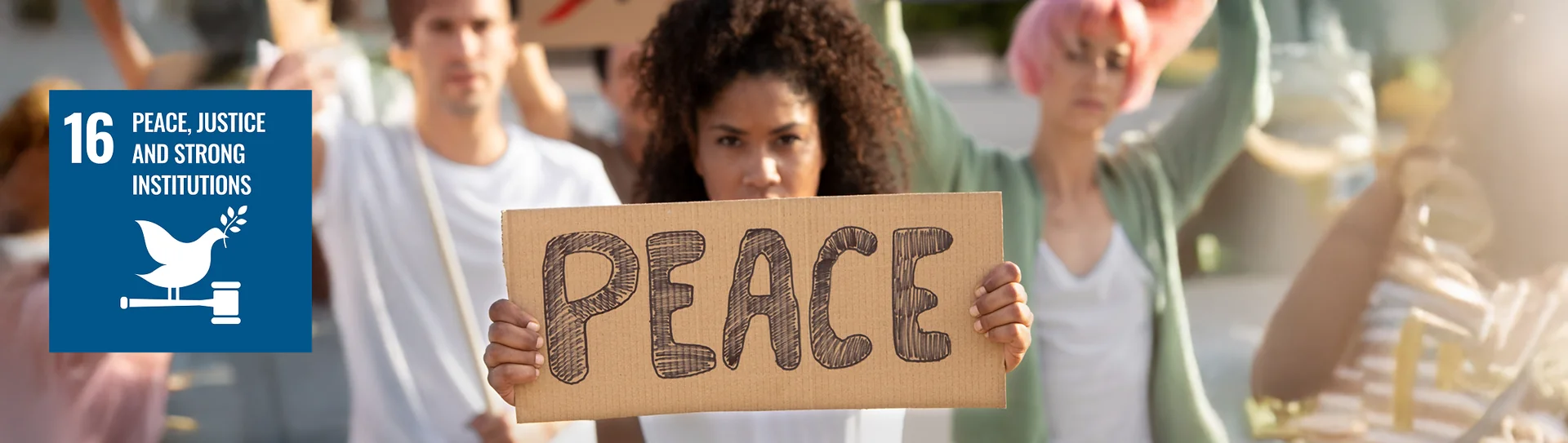
The SDG 16 targets and indicators go beyond infrastructure—they address the very systems that uphold fairness, stability, and rights. SDG 16 sets 12 targets and 24 indicators that measure progress toward reducing violence, ensuring justice, fighting corruption, strengthening governance, and protecting freedoms.
Targets | Indicators |
|---|---|
| 16.1 Significantly reduce all forms of violence and related mortality rates everywhere | 16.1.1: Victims of intentional homicide per 100,000 people, broken down by age 16.1.2: Conflict-related deaths per 100,000 population, by age and cause 16.1.3: Share of population exposed to (a) physical, (b) psychological, or (c) sexual violence in the last 12 months 16.1.4: Percentage of people who feel safe walking alone in their local area |
| 16.2 End abuse, exploitation, trafficking and all forms of violence against and torture of children | 16.2.1 Children aged 1–17 years who experienced physical punishment or psychological aggression 16.2.2 Human trafficking victims per 100,000 population 16.2.3 Young women and men (18–29 years) who faced sexual violence before turning 18 |
| 16.3 Minimize and address impacts of ocean acidification | 16.3.1 Victims of violence who report incidents to authorities 16.3.2: Unsentenced detainees as a share of the total prison population 16.3.3: People who faced a dispute and were able to access a resolution mechanism |
| 16.4 By 2030, significantly reduce illicit financial and arms flows, strengthen recovery and return of stolen assets and combat all forms of organized crime | 16.4.1: Total value of illicit financial inflows and outflows. 16.4.2: Percentage of seized, found, or surrendered arms that are traced or confirmed. |
| 16.5 Substantially reduce corruption and bribery in all their forms | 16.5.1: People who had contact with public officials and paid or were asked for a bribe. 16.5.2: Businesses interacting with public officials that paid or were asked for a bribe |
| 16.6 Develop effective, accountable and transparent institutions at all levels | 16.6.1 Government spending as a proportion of the approved budget, by sector 16.6.2: Citizens satisfied with their most recent experience of public services |
| 16.7 Increase economic benefits from sustainable marine resources to small island developing states by 2030 | 16.7.1 Share of positions in public institutions held by women, people with disabilities, and minority groups 16.7.2 Percentage of population that believes decision-making is inclusive and responsive |
| 16.8 Broaden and strengthen the participation of developing countries in the institutions of global governance | 16.8.1 Proportion of membership and voting rights held by developing nations in international organizations |
| 16.9 By 2030, provide legal identity for all, including birth registration | 16.9.1 Children under five whose births are officially registered with civil authorities. |
| 16.10 Ensure public access to information and protect fundamental freedoms, in accordance with national legislation and international agreements Ensure public access to information and protect fundamental freedoms, in accordance with national legislation and international agreements | 16.10.1 Number of killings, kidnappings, arbitrary detentions, or torture of journalists, media workers, trade unionists, and human rights defenders. 16.10.2 Countries with legal or policy frameworks guaranteeing public access to information. |
| 16.a Strengthen relevant national institutions, including through international cooperation, for capacity building in particular to prevent violence and combat terrorism and crime | 16.a. Existence of independent national human rights institutions that comply with the Paris Principles |
| 16.b Promote and enforce non-discriminatory laws and policies for sustainable development | 16.b.1 Percentage of population reporting discrimination or harassment on grounds prohibited under international human rights law. |

Achieving SDG 16: Peace, Justice, and Strong Institutions faces significant and multifaceted challenges globally.
Core obstacles include ongoing conflicts, widespread corruption, fragile and weak governance structures, and persistent human rights violations that collectively hinder progress.
Millions remain vulnerable due to institutions that lack the capacity or independence to effectively deliver justice or protect fundamental rights. Additionally, the rise of authoritarianism and the shrinking of civic spaces severely restrict public participation and reduce transparency in decision-making processes.
Corruption remains a critical challenge that directly undermines SDG 16 goals. It corrodes trust in institutions, fosters inequality, and fuels cycles of injustice and exclusion. Many countries struggle with entrenched corruption within public sectors, law enforcement, and judicial systems, which impedes fair access to justice and equitable governance.
The complexity of the digital era adds both opportunities and risks. While digital tools have the potential to enhance transparency, increase government accountability, and improve access to justice through online platforms, they also facilitate new challenges such as misinformation, cybercrime, and online hate speech. These digital threats erode institutional trust and can exacerbate social divides.
Systemic inequalities whether economic, social, or political perpetuate cycles of unrest and violence, making it harder to sustain peaceful and just societies. Addressing these inequalities requires comprehensive reforms that consider marginalized communities, enhance legal protections, and foster inclusive governance.
Lastly, progress on SDG 16 is hindered by fragmented policies, limited resources, and coordination challenges across sectors and governance levels. Political instability, limited fiscal space, and external shocks such as pandemics or conflicts further exacerbate difficulties in delivering on promises of peace, justice, and strong institutions.
Overall, concerted action is needed to strengthen institutions, combat corruption, protect rights, and harness technology responsibly to accelerate SDG 16 achievement by 2030
The way forward to achieve SDG 14 (Life Below Water) entails a comprehensive set of strategic actions and policy recommendations:

Develop and deploy digital platforms such as open governance tools, online justice services, and real-time monitoring systems that enhance transparency, accountability, and access to legal systems.

Empower local innovators and civil society actors to design technology-driven solutions that address specific governance and justice challenges on the ground.

Use AI for predictive analytics in conflict prevention, early-warning systems, and enhanced legal research and decision-making processes.

Ensure affordable and inclusive internet access, particularly in underserved and rural areas, to strengthen citizen engagement and access to justice.

Develop frameworks to safeguard against misinformation, cybercrime, and digital exclusion that can undermine institutional trust and social cohesion.

Collaborate across governments, private sector, academia, and civil society to scale innovative solutions that advance peace, justice, and strong institutions.
Achieving SDG 16: Peace, Justice, and Strong Institutions is a shared journey that calls for everyone’s involvement. Governments must lead by building fair, transparent, and inclusive systems that protect the rule of law and guarantee justice for all.
Civil society gives voice to marginalized communities and keeps leaders accountable, while businesses can strengthen trust through ethical practices and strong action against corruption. Academic and international organizations bring knowledge, data, and cooperation to connect local action with global progress.
Most importantly, real change depends on people, choosing inclusion over division, dialogue over silence, and respect over exclusion. When institutions and communities work hand in hand, grounded in trust and responsibility, peaceful and resilient societies can truly be achieved.

Nilanjana Bhowmick
Position your organization with strategies built around your industry realities.
SDG 16 is one of the United Nations' Sustainable Development Goals focused on promoting peace, ensuring justice, and building strong, accountable institutions. It’s about making sure everyone feels safe, laws are fair, and governments serve their people with honesty and transparency.
Because without peace and justice, nothing else can truly thrive. Corruption, violence, and weak institutions hold back progress on everything—from education to healthcare to climate action. SDG 16 helps build the trust and fairness needed for a better future.
We achieve it by reducing violence, fighting corruption, making justice accessible to all, and building institutions that are transparent, inclusive, and accountable. It also means empowering people to participate in decisions that affect their lives.
SDG 16 is all about creating societies where people live without fear, have access to justice, and trust their governments. It covers everything from protecting human rights and reducing crime to ensuring public access to information and promoting the rule of law.
SDG 16 guides countries and communities toward building fairer, more peaceful, and inclusive societies. It sets targets for reducing violence, strengthening laws and institutions, ensuring access to justice, and protecting the rights of all people, especially the most vulnerable.