ISO 14040:2006
Provides the framework and principles for conducting LCAs. It outlines the four phases of an LCA: goal and scope definition, life cycle inventory analysis, life cycle impact assessment, and interpretation. Though ISO 14040 presents the guidelines for carrying out an LCA, it does not instruct the specific ways to do so.

In this stage, the goal and scope of the assessment are described, which encompasses the reason for carrying out the assessment and the intended application and audience. The whole stage involves defining the quantitative measure of the functional unit, the system boundaries, the limitations of the study, allocation of environmental impacts and such more.

Enter Subheading para
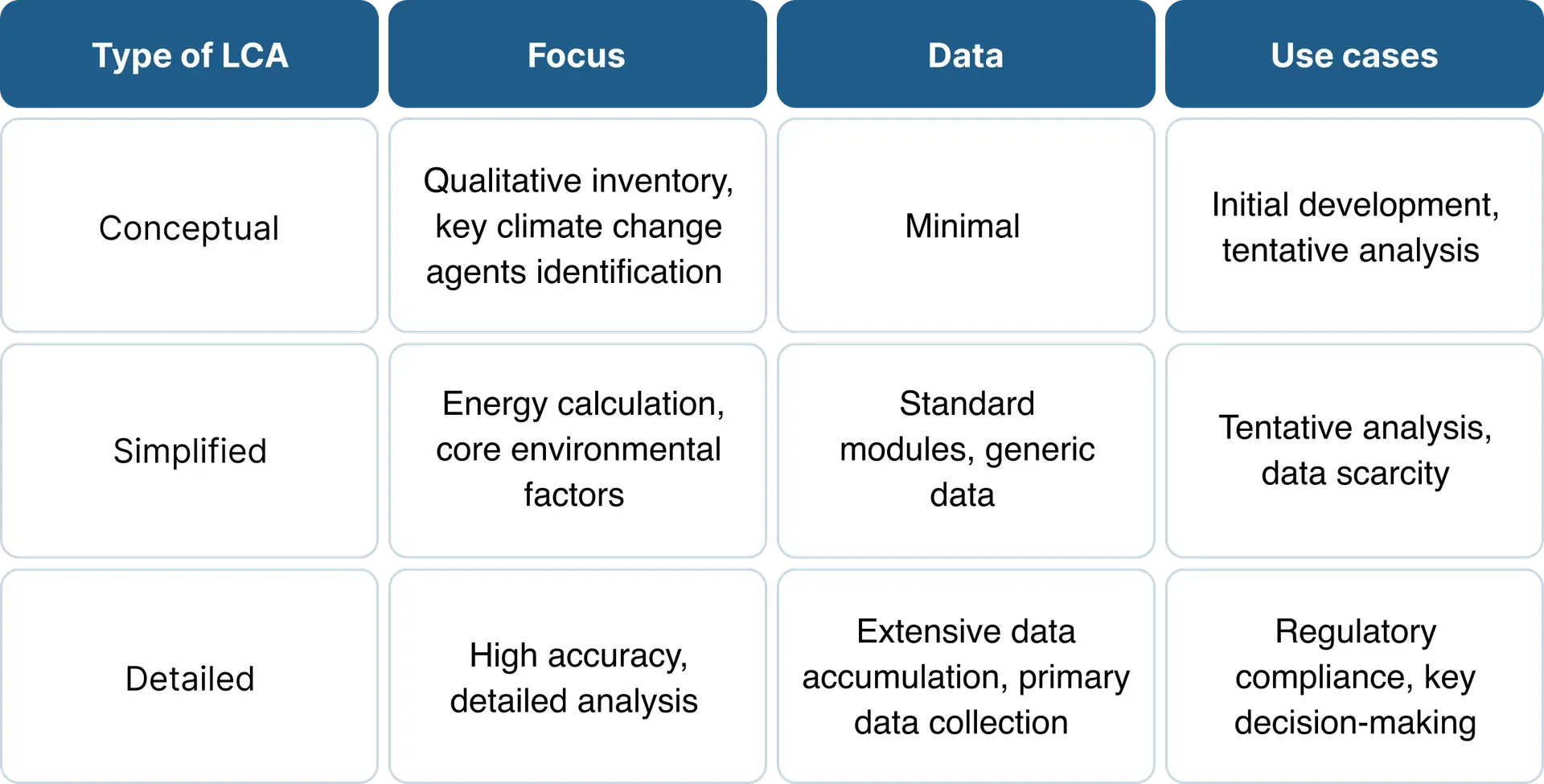
More often than not, LCA seems like an easy task to perform; however, it can be quite complicated and expensive to carry out since it involves accumulating exhaustive climatic data throughout every phase of a product’s life cycle. To resolve the issue, adoption of simplified LCA is on the rise since they offer immediate verification of a product’s life cycle. This type of LCA is basically advantageous for those businesses which needs quick, preliminary assessment with less resources and limited data. However, for a successful LCA, accessibility to more reliable data has become a prerequisite. Due to this, the European Union and international bodies are actively working to improve the accessibility of reliable data for LCA. Since lifecycle analysis places the utmost emphasis on the climatic impacts, it clearly denotes that the social and economic challenges are often not looked at. Moreover, when global environmental impacts like climate change are assessed, the LCA often falls short of assessing localized effects, e.g. they may not adequately capture the potential effects of emissions on local air and water quality, which can significantly impact human health and ecosystems. This limitation arises from the challenge of accurately predicting and quantifying the dispersion and fate of emissions at the local level, which can be influenced by complex factors like local meteorology, topography, and land use.
The sustainability advisors of Cognitud are experienced professionals who advise businesses with best practices in relation to Life Cycle Assessment. They have years of expertise under their belt to guide you through the steps that are needed to perform an LCA in the most reliable and accurate manner.
Our dedicated and committed sustainability advisors will start off by defining the purpose and scope of LCA while also determining the key stakeholders and their perspectives.
Then our Life Cycle Assessment consultants will gather data on the inputs and outputs of the product from various sources like lifecycle inventory or environmental databases or interviews with company stakeholders and suppliers while performing a thorough examination of the product’s raw material extraction to its end-of-life.
Afterward, the advisors review the climatic impact of the product across different categories, such as resource depletion, climate change, and human health. It is worth noting that our sustainability experts make use of well-recognized impact assessment or LCA tools and techniques.
Lastly, our professionals will study the outcome of the impact assessment to identify the most critical impact. With the help of reports, the findings will be shared with the client to maintain utmost transparency.
Cognitud’s sustainability experts have the potential to show the specific areas where implementing a particular environmental initiative will bring about real change, thus ensuring a huge return on your investments.
They will also make sure that you, as a business, are aware of various styles of assessment methods, which will help you easily understand the LCA report while simultaneously being more informed about the all-inclusive sustainability landscape.
A global consulting firm like Cognitud that truly understands and addresses client needs can embody a customer-centric approach in the dynamic field of sustainability.


Abhigyan Gupta
Advance your strategy with solutions calibrated to your market environment.
Life Cycle Assessment (LCA), also known as Life Cycle Analysis, is a method defined by ISO 14040 for evaluating a product or service’s environmental impact throughout its entire life cycle, from raw material extraction and processing to end-of-life.
The purpose of LCA is to identify environmental, social, and economic impacts across a product’s life cycle, helping businesses mitigate climate impact, ensure regulatory compliance, and make more sustainable decisions.
LCA works through a structured, iterative process of setting goals and scope, collecting data on inputs and outputs, assessing environmental impacts such as climate change or resource depletion, and interpreting results to guide decisions and improvements.
A product life cycle assessment evaluates the environmental footprint of a specific product at each stage of its life, from raw material extraction and production to use, disposal, or recycling, offering insights for sustainable design and development.
The four stages of LCA are goal and scope definition, inventory analysis, impact assessment, and interpretation, as outlined by ISO 14040. Each stage builds on the previous one to provide a comprehensive evaluation.