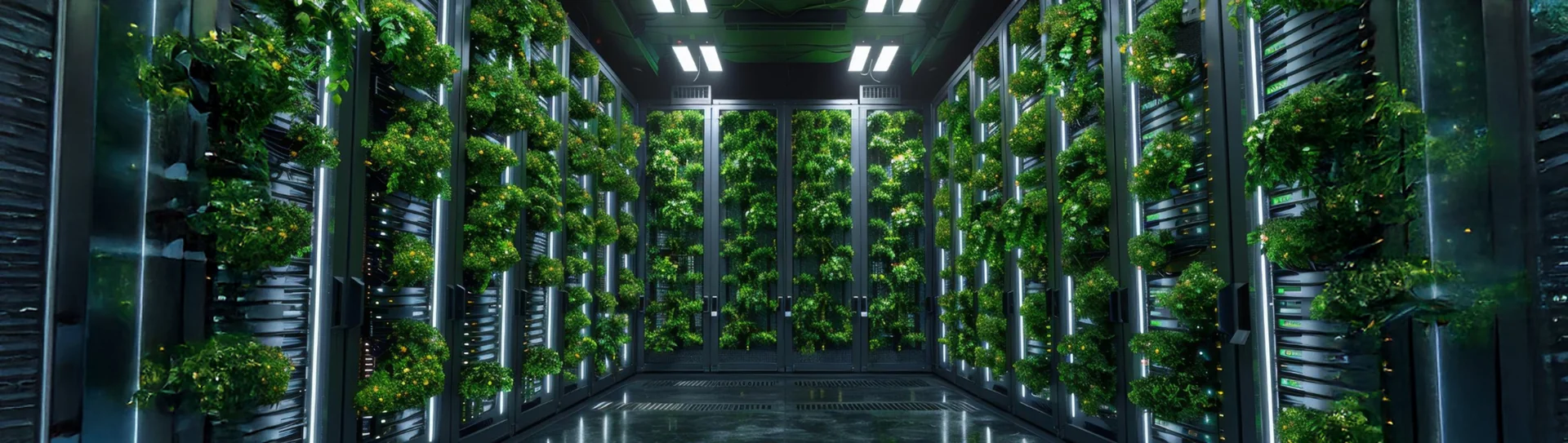
A green data center is a facility specially designed to house IT infrastructure while keeping sustainability in mind. Its main objective is to enhance energy efficiency while reducing environmental impacts. Such structures help with the considerable reduction of carbon emissions and power consumption with the help of renewable energy, modern cooling systems, and sustainable construction. Unlike the traditional data centers that are heavily reliant on fossil fuel-powered sources and inefficient cooling systems, sustainable data centers aim at lowering or neutralizing carbon emissions throughout their lifecycle.
Though digital innovation acts as a ladder to achieve economic growth, it also has its own flaws. Traditional data centers not only consume abundant energy, but their dependence on fossil fuels also leads to significant carbon emissions, which contribute to climate change.
Moreover, the cooling systems of these data centers consume millions of gallons of water every year. Not to forget, the frequent hardware upgrades add up to the increasing global electronic, or e-waste. Today, the regular usage of AI, cloud computing, 5G, and IoT is leaving an unsustainable impact on the environment.
Due to the increased acidity of the ocean, the ocean chemistry experiences massive changes that adversely affect not just aquatic beings but also the human population.
enter para
Enter para
Due to the increased acidity of the ocean, the ocean chemistry experiences massive changes that adversely affect not just aquatic beings but also the human population.

Enter Subheading para
Due to the increased acidity of the ocean, the ocean chemistry experiences massive changes that adversely affect not just aquatic beings but also the human population.

Enter Subheading para
Enter para
Transitioning into sustainable data centers isn’t a smooth ride, as it carries its own set of hurdles. There is an upfront investment at first since green upgrades, like next-gen cooling and renewable energy installations, can turn out to be cost-intensive.
Apart from that, there can be site limitations, as not every region allows hassle-free access to renewable energy or natural cooling, such as sea proximity or cool climates.
There could also be skill gaps, as sustainable data center infrastructure management calls for specific skill sets in energy modeling, green architecture, and ESG reporting.
Upgrading vintage infrastructure can be highly challenging, as the outdated data centers might require severe modifications or complete revamps to align with the green data center standards. However, the long-term environmental as well as financial benefits overshadow the short-term difficulties, making the transition a necessity.
Due to the increased acidity of the ocean, the ocean chemistry experiences massive changes that adversely affect not just aquatic beings but also the human population.
enter para
Enter para
The future of green IT data centers is decentralized, renewable-powered, and exceptionally productive. Governments and regulatory bodies are introducing stricter environmental policies to promote green IT operations. On the horizon, advancements in edge computing and quantum computing might contribute more to sustainability.
Quantum computers can revolutionize data processing by using comparatively less energy than traditional machines. In addition to that, edge computing will lower the requirement for large and centralized data centers by processing information closer to the source, which will further reduce the overall energy use.
Moreover, we can see the implementation of circular IT strategies that emphasize reusing and recycling hardware to reduce e-waste. With the increasing focus on net-zero goals, it will not be long before green data centers emerge as the default standard across various industries.
At Cognitud, we help technology companies translate sustainability ambition into measurable, operational results through targeted, data-driven solutions. Here’s how:
Comprehensive Sustainability Assessments: Identify inefficiencies in cooling systems, power usage, and lifecycle management through detailed performance audits and benchmarking.
Cooling Optimization Frameworks: Implement AI-enabled control systems, economizers, and liquid cooling pilots that deliver measurable reductions in both energy and water consumption.
Renewable Energy Integration: Provide support in structuring Power Purchase Agreements (PPAs), developing on-site solar or wind generation, and deploying energy storage solutions aligned with business continuity and emissions goals.
Circular and Responsible Procurement: Develop circular procurement models, establish certified refurbishment and recycling partnerships, and integrate e-waste traceability within ESG reporting frameworks.
Strategic Implementation and Reporting: Combine engineering precision with sustainability strategy to transform data centers into resilient, low-carbon assets, ensuring digital growth and environmental responsibility advance together.
Through strategic engineering and sustainability expertise, Cognitud enables tech firms to build data centers that are not just efficient but resilient, low-carbon, and future-ready.


Abhigyan Gupta
Advance your strategy with solutions calibrated to your market environment.
A green data center is a facility designed to house IT infrastructure while minimizing environmental impact through energy-efficient design, renewable energy integration, advanced cooling systems, and sustainable construction practices. Its aim is to significantly reduce carbon emissions and power consumption across its lifecycle.
Energy efficiency is essential because traditional data centers consume vast amounts of electricity and water, driving high carbon emissions and operational costs. Improving efficiency reduces environmental impact, enhances resilience, supports regulatory compliance, and strengthens long-term business sustainability.
Technology supports sustainability by enabling energy optimization, efficient cooling, renewable energy integration, and smarter resource management. Tools such as virtualization, AI-enabled cooling, advanced analytics, and modern storage systems reduce power use, minimize waste, and improve overall operational performance.
Among the common solutions, liquid cooling is considered one of the most efficient systems because it removes heat more effectively by immersing servers in specialized fluids. Free cooling using ambient air and hot/cold aisle containment also significantly enhance thermal efficiency while lowering power demand.
Major barriers include high upfront investment costs, site limitations that restrict access to renewable energy or natural cooling, and skill gaps in areas such as green architecture, energy modeling, and ESG reporting. Aging infrastructure can also make upgrades difficult, requiring extensive modifications or full redesigns.