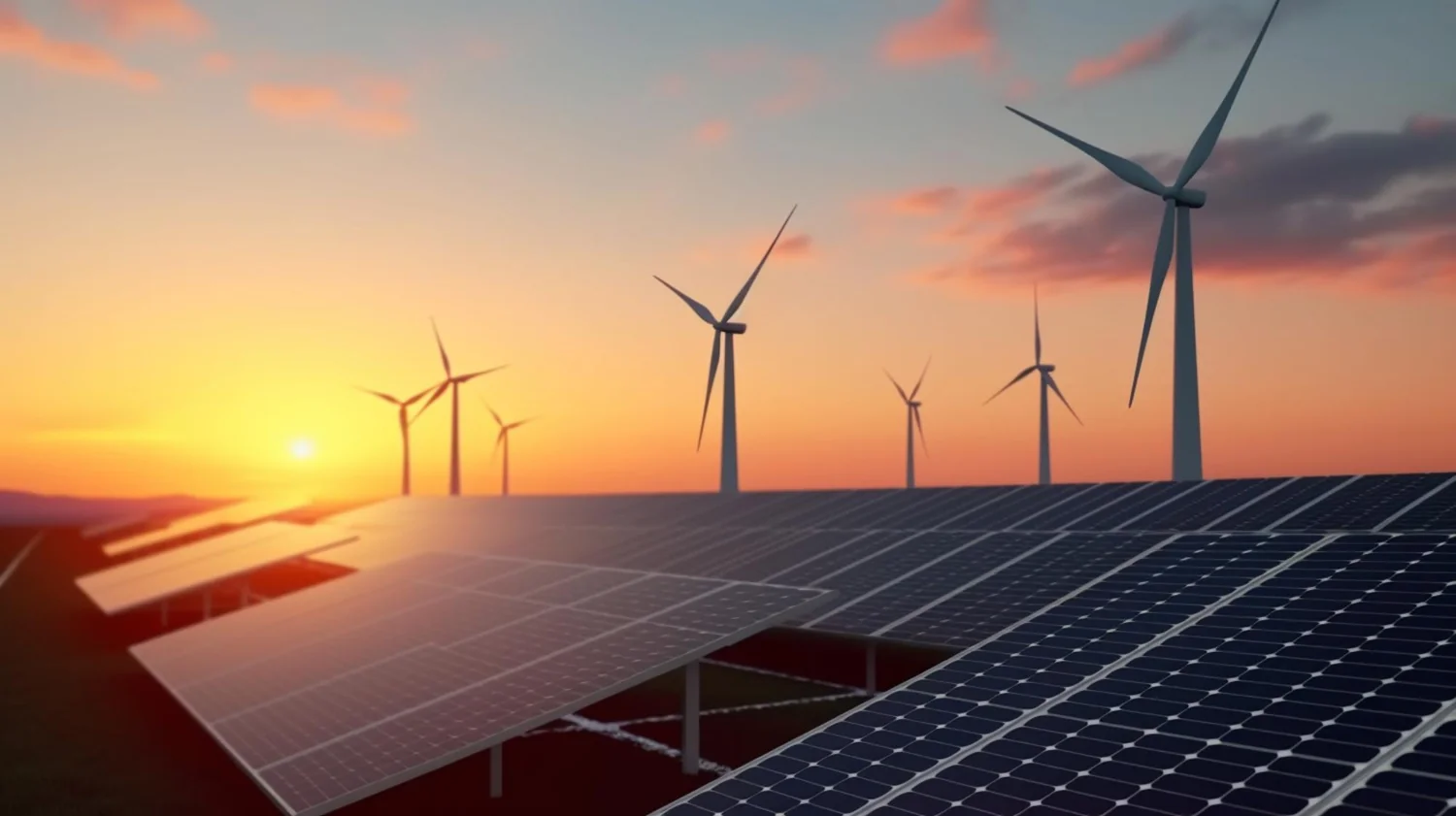

The energy transition has moved from aspiration to arithmetic. Global investment in clean energy hit a record $2.3 trillion in 2025, up 8% from the prior year, according to BloombergNEF, outpacing fossil fuel supply investment for the second consecutive year. Solar and wind together accounted for nearly 97% of all net renewable capacity additions in 2024, driven by falling technology costs and broad policy support across major economies. The renewables have now surpassed coal as the largest source of electricity generation globally, ending coal's five-decade reign at the top, a milestone the IEA’s Electricity 2026 report confirms is now underway. By 2030, the share of renewables in global electricity generation is expected to climb from 32% to 43%. In more than 80% of countries worldwide, renewable capacity is set to grow faster in the 2025–2030 period than it did over the previous five years. The scale and breadth of this shift mean businesses cannot treat it as a regional or sector-specific development, it is a global economic reality.
The most immediate implication for businesses is economic. The cost of deploying renewable energy systems has declined to the point where, in most markets, new solar and wind capacity is cheaper to build than new fossil fuel capacity. Fixed-mount solar now carries a levelized cost of energy (LCOE) of $0.043 per kilowatt-hour in 2024, 41% cheaper than the least-cost fossil fuel alternative, according to IRENA’s Renewable Power Generation Costs in 2024 report. For energy-intensive operations, this cost gap is not marginal, it is a structural pricing advantage available to businesses that move proactively. Businesses that lock in long-term renewable energy procurement through Power Purchase Agreements (PPAs) gain a further advantage: price certainty over periods of 15–20 years, insulating operations from fossil fuel market volatility. This is not just an environmental preference but a treasury and risk management decision. Corporate procurement of clean energy is already a major market force—in the United States, corporate buyers have voluntarily contracted more than 40% of all solar and wind capacity added over the past decade. Dependence on non renewable energy carries a compounding risk premium that is only growing. Carbon disclosure requirements are tightening across major jurisdictions. Investor scrutiny of energy-related emissions is intensifying. Businesses still running on fossil-fuel-dominated grids without a credible transition plan face rising insurance costs, regulatory penalties, and capital access constraints—risks that are quantifiable today, not hypothetical tomorrow.
Understanding where clean energy is scaling fastest matters for businesses with global footprints or international supply chains. China leads by a substantial margin, accounting for nearly two-thirds of all renewable capacity added globally in 2024. India is growing faster proportionally than any other major economy, making it an increasingly attractive destination for manufacturing operations seeking low-cost, grid-accessible clean power. The European Union, backed by its REPowerEU strategy, and the United States, supported by the Inflation Reduction Act, are both on track to double their pace of renewable capacity growth by 2030. For multinationals, this reshapes supplier evaluation, manufacturing location decisions, and operational footprint planning. Energy cost competitiveness is no longer fixed, it is increasingly tied to the pace of clean energy deployment in each geography. Markets that are rapidly decarbonizing their grids offer businesses a structural input cost advantage that markets lagging on the transition do not.
The most important strategic insight is that acting now is substantially cheaper than acting under regulatory pressure later. The primary source of clean energy for most businesses will be the grid itself but only if businesses take deliberate steps to understand their current energy exposure, measure their Scope 2 emissions accurately, and build a credible procurement roadmap. A credible renewable energy solution does not require a business to generate its own power. PPAs, green tariffs, renewable energy certificates, and on-site generation all offer pathways suited to different scales and operational models. What they share is that they require active decisions, not passive waiting for the market to resolve the question on a business's behalf. The transition also extends beyond electricity. Heat, transport, and industrial processes are all moving toward electrification and renewable integration. Businesses that begin mapping these dependencies now, and building transition pathways across their full energy footprint, will be better positioned for both regulatory compliance and operational resilience than those who limit their planning to grid electricity alone. Clean energy's rapid scaling is not a story that favors the unprepared. It favors organizations that understand the economics clearly, move decisively on procurement, and integrate energy transition planning into their core business strategy. The window for low-cost, proactive transition is open but it is narrowing.
Cognitud helps businesses translate the scale of the clean energy shift into practical strategy. From energy audits and Scope 2 reduction roadmaps to PPA advisory and transition risk integration, Cognitud’s environmental consultants work with organizations to identify exposure, quantify opportunity, and build credible clean energy commitments that hold up under regulatory and investor scrutiny. In an accelerating transition, having the right strategic framework is not optional, it is foundational.


Nilanjana Bhowmick
Position your organization with strategies built around your industry realities.