
Cognitud
  • About Us
  • Case Studies
  • Insights
  • News
  • Careers
  • Contact Us
Cognitud
About UsCase StudiesInsightsNewsCareersContact Us

Transforming business,
responsibly!

Cognitud

Company

  • About Us
  • Contact
  • Careers

Our Work

  • Solutions
  • Insights
  • Events
  • ESG Playbook
  • Procurement Playbook
  • LinkedIn
  • Instagram
  • Youtube
  • Facebook
  • X

Subscribe to our newsletter

© 2026 Cognitud. All rights reserved.

Cookie policy

We use cookies.

We use cookies to help Cognitud run properly and to make your visit more useful. Cookies are small pieces of information stored on your browser when you visit a website — they can hold details about you, your preferences, or your device, and are mostly there to make the site work the way you’d expect. In most cases they don’t identify you personally; they simply support a smoother, more relevant experience.

Because we take your privacy seriously, you decide which categories of cookies to allow. Switching some off may change how parts of the site behave or limit the services we can offer you. For a full breakdown of what each category does and how long we keep your consent, see our Cookie policy.

ARTICLE

UAE Climate Change Law: A Game-Changer for Sustainability

UAE has moved a big step forward in combating climate change with the adoption of Federal Decree-Law no. (11) of 2024 “Reduction of Climate Change Effects.” By building a solid regulatory framework, the climate law for the UAE will create a leading climate change legal agenda to support the country’s Net Zero 2050 strategy.

The law gives legal recognition to MOCCAE to enforce climate-related resolutions including emission reporting and reduction across public and private sectors including free zones so as to help the UAE move towards a sustainable low carbon future.

Banner
Article1

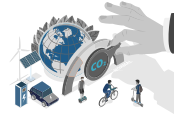
It defines key terms in the UAE’s Climate Change Law, including "The State" (UAE), "The Ministry" (Ministry of Climate Change and Environment), and "Competent Authority" (local and federal bodies). It explains the change of climate, greenhouse gases (e.g., CO2, methane), and emissions from human activities. It covers concepts like climate mitigation, adaptation, emissions tracking, carbon credits, carbon capture technologies, and achieving climate neutrality, aligning with national and global strategies like the Paris Agreement.

Article2

It mentions the objectives of the law, such as:

  1. Contributing to international endeavor of reducing emissions
  2. Strengthening capacity and infrastructure of the ecosystem
  3. Investing in innovation, research, and development
  4. Structuring data around climate impact
Article3

It clarifies the provision of the law extended to all sources of the State, including free-zones.

Article4

It lists the way in which carbon emissions are reduced. Means of achieving carbon neutrality are:

  1. Clean energy
  2. Carbon Offsetting
  3. Protecting natural carbon sinks like forests and wetlands
  4. Using alternatives to saturated fluorocarbons
  5. Carbon capture, use and storage (CCUS)
Article5

It states that the UAE Cabinet will set yearly goals to reduce emissions across all sectors, working closely with the Ministry of Climate Change and Environment. These goals will:

  1. Be compatible with the country’s climate neutrality goals
  2. Factor in each sector’s economic requirements
  3. Adhere to international standards to enhance UAE’s global competitiveness.
Article6

It emphasizes the significance of precise measurement, reporting, and verification of emissions in the Climate Law. The Ministry is prioritizing an efficient data management tool to streamline data collection, reporting, and integration with existing systems. The Ministry-designated entities are required to:

  1. Measure their emissions on a regular basis
  2. Keep an emissions inventory
  3. Submit reports on a regular basis in accordance with the guidelines established by the authorities
  4. Maintain emission records for a minimum of five years and make them available to authorized officials in order to guarantee accountability.
Article7

It focuses on creating thorough adaptation plans to prepare for the effects of climate change. Plans specific to the infrastructure, energy, environment, health, and insurance sectors, that will be developed by authorities in collaboration with the Ministry of Climate Change and Environment, include:

  1. Evaluation of climate hazards
  2. Response Strategies and Early Warning Systems
  3. Implementation of the plan and adaptation measures
Article8

It emphasizes the necessity of cooperation in climate science by mandating authorities to exchange pertinent data and studies with the Ministry, which includes data, reports, and studies on a regular basis from authorities and pertinent organizations.

Article9

It outlines the authority of the Cabinet to form committees or boards composed of officials from the federal, state, and local governments as well as private sector climate change specialists. These organizations will monitor and evaluate national climate change policies and offer recommendations for solutions to be communicated to the appropriate authorities.

Article10

It outlines the authority of the Cabinet to form committees or boards composed of officials from the federal, state, and local governments as well as private sector climate change specialists. These organizations will monitor and evaluate national climate change policies and offer recommendations for solutions to be communicated to the appropriate authorities.

Article11

It says the Ministry and the competent authority shall work through international cooperation mechanisms to strengthen the State’s profile in mitigation and adaptation to the impacts of climate change.

Article12

It outlines the Ministry’s responsibility to approve and periodically review the Nationally Determined Contributions (NDCs) with appropriate authority and pertinent institutions. It ensures:

  1. Necessary measures are taken
  2. Long-term emission reduction strategy and the national adaptation plan, including addressing loss and damage impacts
Article13

The Ministry, in coordination with the entity concerned, is responsible for preparing and submitting international reports that the State requires, with the types and data chosen by the Minister in consultation with pertinent institutions.

Article14

It grants designated employees, approved by the Minister of Justice or local judicial authorities, the authority to act as judicial officers to identify violations of this Decree-Law and the resolutions in response to the implementation.

Article15

It mentions the penalties and administrative actions for infractions in the Federal Decree-Law of 2024 on the Reduction of Climate Change Effects. Fines for violations of Article 6(1) range from AED 50,000 to AED 2,000,000.

Article16

According to Article 16, if the same infraction is committed within two years following a conviction, the penalty will double.

Article17

It gives the Cabinet the authority to establish administrative sanctions, complaint procedures, and fine distributions after consulting with the appropriate authorities.

Article18

According to this article, the entities must abide by the law within a year, though the Cabinet may decide to extend that time.

Article19

It grants the Minister authority to issue resolutions for enforcement.

Article20

It repeals conflicting provisions.

Article21

It mandates that the law be published in the Official Gazette and come into effect nine months after publication.

Impact of the Law

By combining environmental preservation with national economic goals, the UAE’s new climate law establishes the country as a leader in sustainability. Through sustainable growth, renewable energy, and green technologies, it boosts the economy and supports international objectives like the Paris Agreement. This proactive strategy strikes a balance between environmental responsibility and economic growth, making the UAE a desirable location for partners and investors and serving as a model for other countries making the shift to a low-carbon future.