Article





The International Sustainability Standards Board was established by the IFRS Foundation Trustees on 3 November 2021 at COP26 in Glasgow in response to strong market interest. Its goal is to create top-notch worldwide sustainability disclosure guidelines fulfilling investor expectations and financial market criteria. The people who started the ISSB emphasize that businesses must provide accurate sustainability data. This data helps compare performance across different sectors, as sustainability is becoming more important for investment decisions. According to market feedback, consolidating scattered voluntary sustainability criteria is important to lower costs, streamline processes, and shield companies and investors from risk.
1
Enter Para
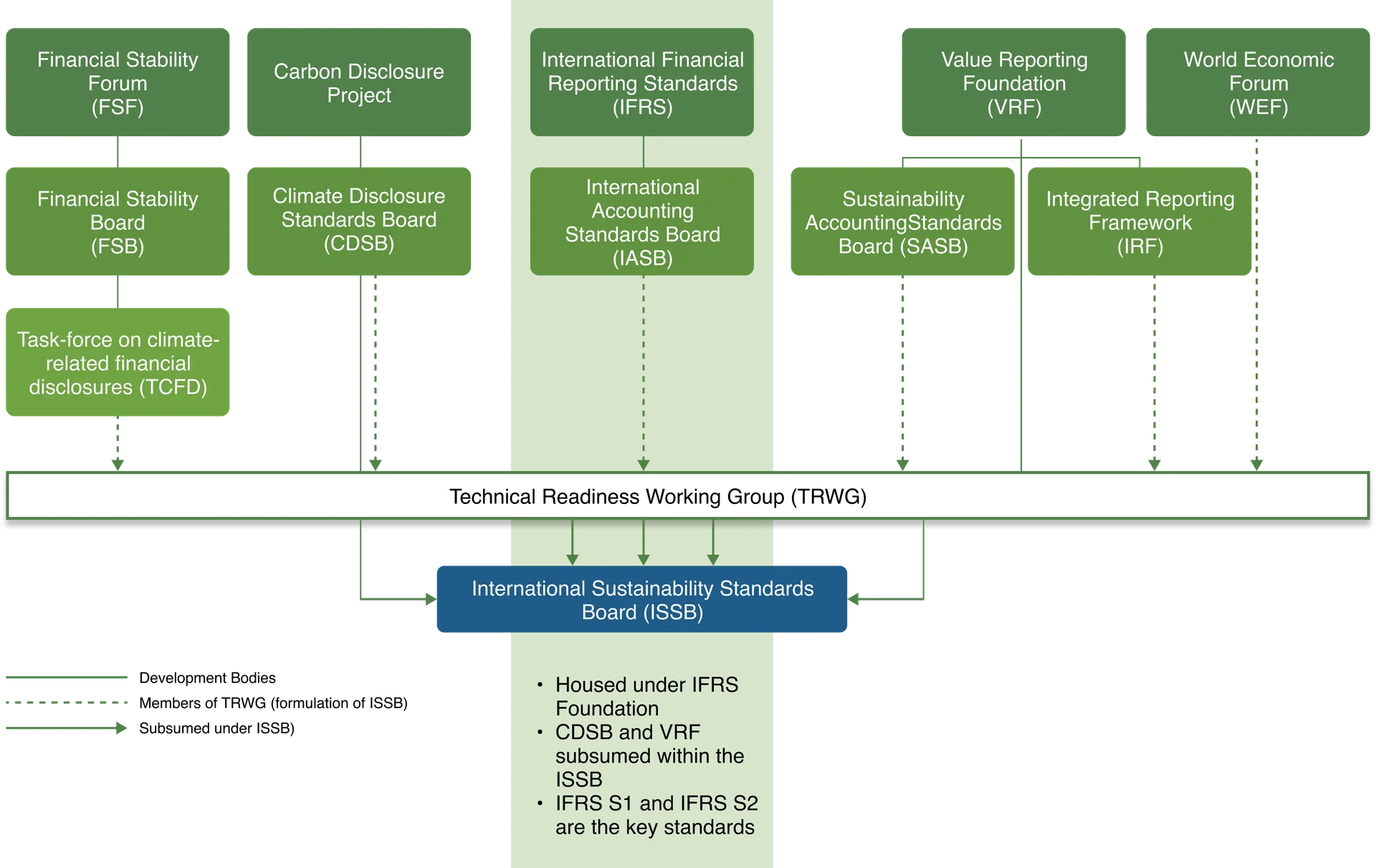
Carbon Disclosure Project (CDP) | 2000 : A nonprofit initiative encouraging companies to disclose environmental impacts. Climate Disclosure Standards Board (CDSB) | 2007 : Established by CDP to standardize corporate climate and sustainability disclosures. ISSB | 2021 : The CDSB was dissolved and integrated into ISSB, contributing to IFRS S1 & IFRS S2.
International Financial Reporting Standards (IFRS) | 2001 : Established to set global accounting standards. International Accounting Standards Board (IASB) | 2001-Present : Develops IFRS accounting standards. ISSB | 2021 : Created alongside IASB under the IFRS Foundation to establish sustainability-related financial disclosure standards.
Integrated Reporting Framework (IRF) | 2010 : Developed principles for integrated financial and sustainability reporting. Sustainability Accounting Standards Board (SASB) | 2011 : Created industry-specific ESG (Environmental, Social, and Governance) standards. Value Reporting Foundation (VRF) | 2021 : Formed by merging SASB & IRF. ISSB | 2022 : VRF was fully consolidated into ISSB, which now integrates SASB’s industry-specific ESG reporting.
World Economic Forum (WEF) | 2020 : Developed Stakeholder Capitalism Metrics for sustainability reporting. ISSB | 2022 : WEF’s work influenced ISSB’s global disclosure standards.
Enter para
Due to the increased acidity of the ocean, the ocean chemistry experiences massive changes that adversely affect not just aquatic beings but also the human population.

Enter Subheading para
The International Sustainability Standards Board (ISSB) does not have any mandatory standards at the global level. However, the adoption of these principles depends on jurisdictional decisions. The ISSB is unable to enforce compliance.
But these standards are already incorporated into the legislation of certain countries, such as the UK and Australia. This growing global recognition implies that in specific regions, disclosure regulations that are exclusively based on ISSB criteria may become mandatory.
The ISSB standards enable the inclusion of any supplementary jurisdictional requirements that may be necessary. By openly implementing such recommendations, companies have the option to adhere to global standards.
Several international locations worldwide adhere to the International Sustainability Standards Board (ISSB). Nations such as the United Kingdom, Brazil, Canada, Singapore, and Japan are integrating these standards, either by fully implementing them or aligning their existing ISSB frameworks with ISSB’s sustainability reporting models.
As of now, India has not yet fully implemented the ISSB standards.
However, it is making progress in sustainability reporting and considering adopting IFRS standards in the country.
The Business Responsibility and Sustainability Report (BRSR) framework was established by the Securities and Exchange Board of India (SEBI). This method is consistent with the ISSB's global practices. It assists Indian corporations in guaranteeing that their disclosures are in accordance with international standards.
This demonstrates India's determination to improve its sustainability reporting strategies. The international locations that have implemented the ISSB standards are interested in organizing an international conference for sustainability disclosures. This initiative has been supported by businesses worldwide, including the Financial Stability Board.
Additionally, it is good for organizations that adhere to the IFRS guidelines to integrate sustainability reporting more effectively into their financial disclosures.
We stand out as leaders in navigating complex regulatory landscapes and global sustainability frameworks, ensuring businesses stay ahead of evolving compliance requirements. With deep expertise in international standards such as ISSB, IFRS, SASB, TCFD, and GRI, we help organizations seamlessly integrate sustainability into their financial and operational reporting. By proactively aligning corporate strategies with ISSB regulations and industry-specific mandates, we not only mitigate compliance risks but also enhance corporate transparency and investor confidence. Our in-depth knowledge of sustainability disclosure requirements enables businesses to streamline reporting processes, avoid redundancies, and maximize the impact of their ESG initiatives. We help you understand new sustainability laws and improve your governance systems to meet regulations effectively. Our expertise gives you the confidence to handle today's compliance challenges clearly and accurately.


Abhigyan Gupta
Advance your strategy with solutions calibrated to your market environment.
The International Sustainability Standards Board (ISSB) is an independent global body established by the IFRS Foundation in 2021. Its purpose is to develop a comprehensive global baseline for sustainability disclosure standards, enabling companies to provide transparent, consistent, and comparable sustainability information to investors and stakeholders. The ISSB’s goal is to integrate sustainability data with financial reporting, supporting better-informed investment and economic decisions.
The ISSB standards themselves are not automatically mandatory at the global level. However, adoption depends on each country’s or jurisdiction’s regulatory authorities. Some governments and stock exchanges may decide to make ISSB standards mandatory for listed or large companies, while others may allow voluntary adoption.
You don’t “apply” to the ISSB as an organization — instead, companies adopt and implement ISSB standards in their reporting processes. To use ISSB standards, organizations can: • Access the official standards and ISSB guidance on the IFRS Foundation website. • Integrate the standards into their sustainability or annual reports. • Train their reporting teams on IFRS S1 (general sustainability disclosure) and IFRS S2 (climate-related disclosure). There’s no formal application process; it’s about implementation and alignment.
The ISSB has issued two initial global sustainability disclosure standards: • IFRS S1 – General Requirements for Disclosure of Sustainability-related Financial Information: Sets out the overall principles and structure for reporting sustainability-related information relevant to enterprise value. • IFRS S2 – Climate-related Disclosures: Focuses specifically on climate-related risks and opportunities, aligned with the Task Force on Climate-related Financial Disclosures (TCFD) recommendations. These standards are designed to work together and in coordination with financial reporting under IFRS.
Organizations can prepare for ISSB implementation by: • Assessing current sustainability reporting practices (e.g., GRI, CDP, TCFD, or local frameworks). • Mapping gaps between existing disclosures and ISSB requirements. • Developing internal data systems for consistent, auditable ESG data. • Training finance and sustainability teams on ISSB standards and IFRS alignment. • Integrating sustainability into governance and risk management frameworks. • Starting early ensures a smooth transition once regulatory adoption increases.