Article




Sustainability has become a crucial aspect of any company’s global strategy. With growing demands from stakeholders for transparency around environmental, social, and governance (ESG) practices, businesses are increasingly being held accountable for their impact on society and the planet. This is where EcoVadis comes into play. As one of the leading platforms for assessing corporate sustainability, EcoVadis offers companies an in-depth look at their ESG performance. By evaluating companies across multiple criteria, EcoVadis helps businesses understand where they stand in terms of sustainability and provides insights into areas for improvement. In this article, we’ll take a closer look at the EcoVadis rating system, exploring the key areas it evaluates—such as environmental impact, labor practices, ethical behavior, and sustainable procurement—and discuss why ESG ratings have become an essential benchmark for organizations across all industries. Whether you’re aiming to improve your sustainability practices or simply understand why ESG ratings matter, this guide will provide you with everything you need to know.
Ecovadis, a web tool for evaluating the performance of environmental, social and governance companies (ESG) companies, was founded in 2007 and is a global leader in sustainability evaluation. The primary goal of EcoVadis is to assess and improve the sustainability and corporate social responsibility (CSR) performance of companies across global supply chains. They aim to help businesses integrate environmental, social, and ethical practices into their operations and procurement processes, fostering transparency, accountability, and continuous improvement between companies and their suppliers. Ecovadis is applicable across a wide range of industries, such as production, retail, construction and services, and also provides sustainability evaluation for companies of all sizes, from small enterprises to global corporations.
EcoVadis is designed for a wide range of businesses looking to strengthen and demonstrate their commitment to sustainability. However, it excludes companies involved in certain industries such as:

Manufacture of tobacco products (ISIC code 1200)
Mining of coal and lignite (ISIC division 05)
Manufacture of weapons and ammunition (ISIC code 2520)
Manufacture of air and spacecraft and related machinery (ISIC code 3030)

These are typically procurement teams or sustainability leaders who invite their suppliers to complete the EcoVadis assessment. They gain access to intuitive scorecards that help monitor suppliers’ sustainability performance and track continuous improvement over time.

These are businesses that respond to a client’s request for assessment. Once rated, suppliers receive a scorecard summarizing their performance, which they can choose to share with clients or other members within the EcoVadis network. Sharing results is entirely optional and secure, offering an opportunity to boost visibility and unlock new business opportunities.
With coverage spanning over 200 purchasing categories, EcoVadis supports businesses across a wide array of industries. Its global network includes over 75,000 companies, including leading organizations such as Coca-Cola European Partners, Salesforce, Verizon, Johnson & Johnson, Subway, Renault-Nissan, ING Bank, and Nokia.
The EcoVadis sustainability rating is built around a globally recognized framework that evaluates companies across four key themes:

Focuses on energy use, emissions, waste management, and resource conservation.
Assesses working conditions, employee well-being, and human rights protections.
Reviews policies and practices related to anti-corruption, fair business practices, and compliance.
Evaluates how companies manage environmental and social practices across their supply chain.
The evaluation process begins with registration on the Ecovadis platform. During this step, the company creates a profile by providing basic details of their business operations and contact information.
After registration, the company will receive a personalized link and instructions - for example, deadlines and other steps to access their Ecovadis account and start the evaluation. Ecovadis will adapt the questionnaire based on factors such as industry, company size and country of operation. The platform supports eight languages: English, French, Spanish, Dutch, German, Italian, Portuguese and Chinese. Although support documents can be uploaded in any language, it is recommended to use one of the supported languages - ideally English - for faster and more efficient control. Buyers can also invite their suppliers to directly participate in the platform, which makes it easier to integrate the sustainability evaluation into the procurement process.
After presenting the questionnaire, EcoVadis analysts will begin a comprehensive review of the answers and all supporting documentation. The company's control panel will indicate which sustainability criteria apply to their evaluation and how each category is graded as moderately important, highly important, or relevant only in regions classified as high-risk. To ensure robust and trustworthy evaluation, analysts not only explore the company's internal documents, but also renowned external sources such as media reports, NGOs and public databases. This holistic overview usually takes about 6 to 8 weeks, depending on the volume and complexity of the information presented.
Once the evaluation is completed, Ecovadis publishes the results directly on the platform. The company is informed by e -mail as soon as the scorecard is available. This Scorecard provides detailed information about the performance of the company across the scheduled topics along with strengths, areas for improvement and comparison.
Each theme is assessed on a scale from 0 to 100, and the overall EcoVadis score is calculated as the average of these theme scores. This overall score determines a company’s eligibility for medals or badges.
Indicates a significant need for improvement in sustainability practices.
Reflects average performance with considerable room for growth.
Demonstrates solid sustainability practices and effective implementation.
Represents leading sustainability performance and best-in-class practices.
EcoVadis not only helps companies to measure their performance of sustainability - also rewards success and progress through a structured system of recognizing medals and badges. These recognitions serve as trusted signals to partners, clients and parties that the company has committed itself to responsible business practices. Medals are awarded to companies that are among the most important organizations around the world, based on their score compared to others rated in the last 12 months.
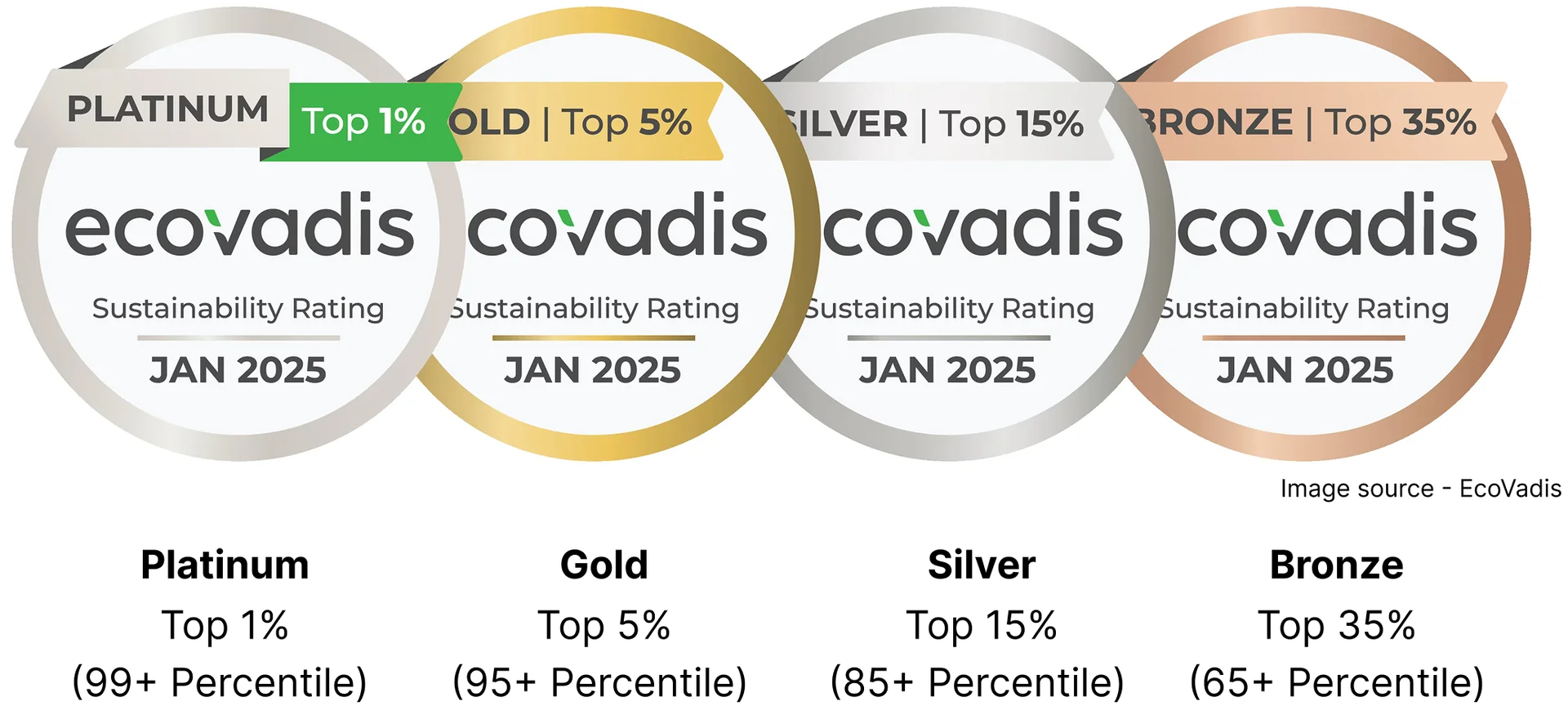
Reach a minimum score of 30 in each of the four topics
They have no serious or more main negative findings in the EcoVadis 360 ° watch that monitor credible external sources such as media reports, NGOs and public databases
While medals recognize top performers, badges highlight companies making significant progress or showing strong commitment to sustainability—even if they’re still on the path to becoming top-tier.
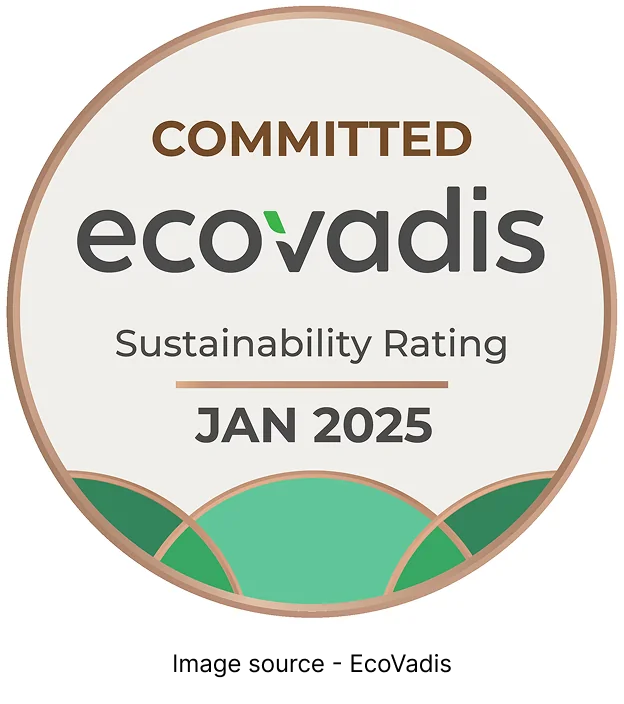
Awarded to companies that achieve a minimum overall score of 45, demonstrating a “Good” level of sustainability performance.
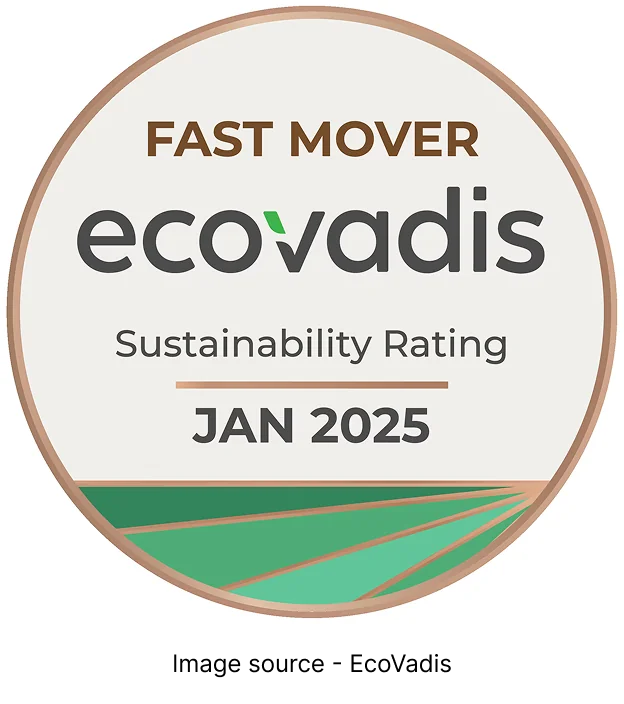
Given to companies with a score between 34 and 44 who show marked improvement—a minimum of 6-point increase from their previous assessment within 18 months.
In order for companies to qualify for the badge, companies must meet the following criteria:
Just like with medals, companies must not have serious or multiple major negative findings in the 360° Watch to be eligible.
Having your company’s sustainability practices verified by EcoVadis adds credibility to your claims and reinforces your commitment to transparency and accountability. A strong EcoVadis score can set your business apart, enhance your brand reputation, and serve as a key differentiator when it comes to securing investments, winning new business, and attracting customers. In fact, research shows that 91% of companies factor sustainability ratings into their purchasing decisions. EcoVadis also enables performance benchmarking, allowing you to measure your progress against industry peers. Alongside your score, you receive a tailored corrective action plan to help identify improvement areas and boost future performance. Beyond internal benefits, EcoVadis plays a vital role in sustainable supply chain management. Buyers can use the platform to send customized assessments to their suppliers, gain deeper insight into potential sustainability risks, and strengthen responsible procurement practices.
While EcoVadis is highly regarded for its detailed supplier assessments and practical insights into supply chain sustainability, it also has certain limitations that can affect its standalone effectiveness as a sustainability benchmarking tool:

EcoVadis focuses heavily on supply chain sustainability, assessing companies primarily on their environmental, labor, ethics, and procurement practices. However, it may not capture broader ESG strategy, governance structures, or sector-specific material issues that are typically covered in frameworks like DJSI.
Unlike DJSI, which is designed with investors in mind, EcoVadis is not an investment-oriented benchmark. This makes it less useful for stakeholders seeking a financial lens on sustainability performance.

EcoVadis assessments are largely based on self-reported documentation and can vary in depth based on company size or documentation submitted. This may lead to inconsistencies in scoring and make cross-company comparisons less robust.

EcoVadis reports are primarily shared between buyers and suppliers, and are not always publicly accessible. This creates a lack of transparency that may hinder broader stakeholder engagement.

Compared to frameworks like CDP, EcoVadis does not provide specialized carbon emissions or climate risk disclosures. This limits its value for companies or investors focusing specifically on environmental performance or net-zero strategies.
Cognitud specializes in guiding companies through the EcoVadis assessment process with a strategic, end-to-end approach. From preparing tailored documentation to aligning company practices with EcoVadis criteria across Environment, Labor & Human Rights, Ethics, and Sustainable Procurement, Cognitud ensures businesses are well-positioned to score higher. Our expert team helps you decode the questionnaire, identify gaps, and implement effective corrective actions to enhance both readiness and performance. With a deep understanding of the EcoVadis methodology and industry-specific requirements, we go beyond compliance to help you build a credible, long-term sustainability foundation. Whether you're pursuing your first score or aiming to elevate your medal status, we are your dedicated partner in achieving and demonstrating ESG excellence through EcoVadis.


Abhigyan Gupta
Advance your strategy with solutions calibrated to your market environment.
EcoVadis is a globally recognized sustainability rating platform that assesses companies on their environmental, social, and governance (ESG) practices. It evaluates businesses across four key areas — Environment, Labor & Human Rights, Ethics, and Sustainable Procurement — providing a scorecard that helps organizations understand and improve their sustainability performance.
To obtain EcoVadis certification, a company must register on the EcoVadis platform, complete a tailored sustainability questionnaire, and submit supporting documents. EcoVadis analysts then review and score the submission. Based on the score, companies may receive a Bronze, Silver, Gold, or Platinum medal, which serves as the EcoVadis certification mark.
EcoVadis works through a four-step process: • Registration – Companies create an account and provide basic details. • Questionnaire – A customized survey is filled out based on industry, size, and location. • Evaluation – EcoVadis experts review documents and external sources to verify data. • Scorecard – The company receives a detailed score (0–100) with strengths, weaknesses, and improvement suggestions. This process provides a transparent view of a company’s sustainability practices and progress.
You can check your EcoVadis score directly on the EcoVadis platform once the assessment is complete. The scorecard shows your overall rating and breakdown by theme (Environment, Labor & Human Rights, Ethics, and Sustainable Procurement). Suppliers can also share their scorecards with clients or partners securely within the platform.
To improve your EcoVadis score, focus on: • Strengthening policies and measurable ESG goals • Submitting clear, updated supporting documents • Implementing corrective actions from your previous scorecard • Enhancing transparency and supplier sustainability management Many companies partner with EcoVadis consultants to identify gaps and develop a structured improvement plan.