Article




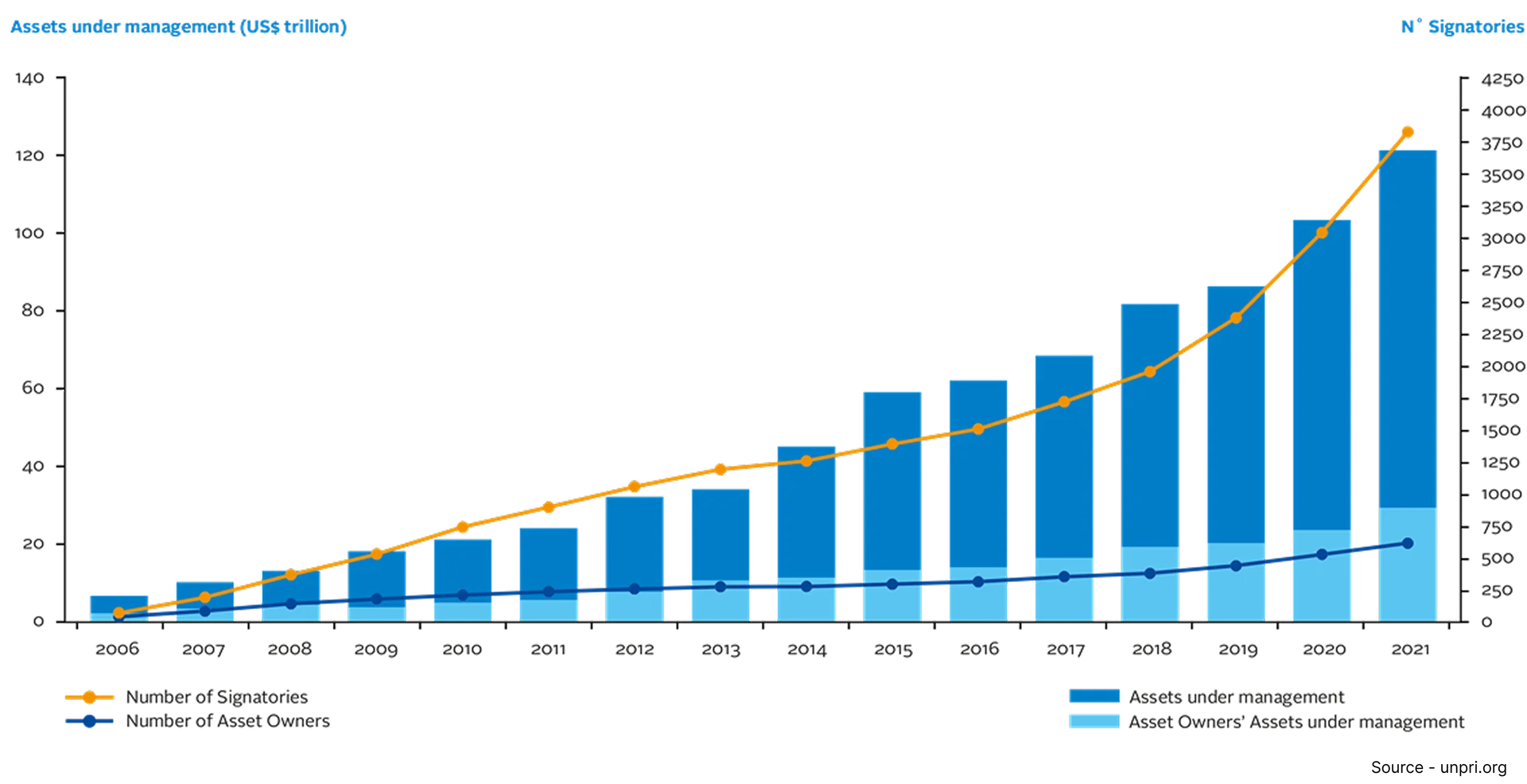
The UN Principles for Responsible Investment (PRI) is a leading international organization dedicated to promoting responsible investment by encouraging the integration of environmental, social, and corporate governance (ESG) factors into investment decision making. With the help of the UN, the PRI was first launched at the New York Stock Exchange in April 2006 with just 100 signatories and has since expanded to include more than 4,900 participating financial institutions globally. These signatories committed to uphold six fundamental principles that foster sustainable development, risk management, and long-term value creation. Collectively, they oversee assets worth over $100 trillion. Irrespective of size, location, or stage in the responsible investment journey, members must report on their progress annually as part of the voluntary disclosure requirement for participation. Through an active global network of investors, PRI enables knowledge-sharing, policy-shaping, and best practice, supporting the growth of ESG integration throughout the financial sector.
A diverse range of investment management organizations are signatories to the United Nations Principles for Responsible Investment (UN PRI). These consist of:
Pension schemes, endowments, foundations, insurance companies, sovereign wealth funds, and family offices.
Asset managers (multi-asset or single-asset) managing funds on behalf of clients.
Firms that offer services to investors, including investment advisers, sustainability consultants, assurance providers, rating agencies, data/research providers, brokerage firms, proxy voting firms, and stock exchanges.
Some banks have adhered to the UN PRI in order to align their lending and investment strategies with the practice of ESG.
Sovereign wealth funds take care of national assets and usually incorporate ESG principles to facilitate sustainable growth in the economies of their respective countries.
Endowments from universities, foundations, and others employ ESG principles to ensure that their investments are aligned with their respective missions.
Insurance companies also employ responsible investment principles to take care of climate change-related risks, governance breakdown, or social problems.
A few academic institutions engaged in research and education on responsible investment have signed up to make contributions and share innovation in ESG practices.
Some individual investors have also signed up with the UN PRI network though less frequent than companies, to show support for sustainable investing.

By taking into account ESG factors that conventional financial analysis might overlook, PRI signatories are better equipped to make wise investment choices. This strategy facilitates the creation of long-term value, aids in the identification and mitigation of significant risks, and permits more resilient and sustainable financial returns. The PRI framework empowers investors with the capabilities to better manage ESG-related risks and adjust portfolios to new market realities.

Adopting the PRI reflects a strong commitment to aligning investments with broader societal and environmental goals. Investors can position themselves as agents of positive change by actively addressing global issues like inequality, climate change, and social impact and helping economies transition toward sustainable ones through ESG integration.

Joining the PRI signatory gives you access to a global network of progressive investors who are working together to shape the direction of responsible investing.Signatories work together on projects, exchange knowledge, and join forces on collaborative efforts to drive ESG standards and shape the wider financial system.

Signatories have exclusive access to PRI's extensive collection of case studies, research, implementation resources, and policy insights. Additionally, organizations can develop their ESG expertise and stay up to date with changing sustainable finance best practices by taking advantage of discounted access to PRI Academy courses.

Annual reporting under the PRI framework enables signatories to evaluate and report on their ESG integration. Transparency improves stakeholder trust, facilitates benchmarking against industry peers, and encourages ongoing improvement.

Affiliation with the PRI signals integrity and leadership in responsible investment. PRI signatories distinguish themselves as reputable, forward-thinking organizations that place a high value on accountability and long-term impact as investor expectations and regulatory standards change.

The PRI is the industry standard for responsible investment. By becoming a signatory, your institution formally declares that it supports internationally accepted principles and contributes to the push for a more sustainable financial future.
While acknowledging that environmental, social, and corporate governance (ESG) concerns can have a substantial impact on investment performance, signatories to the Principles for Responsible Investment (PRI) commit to adhere to six fundamental principles that represent their duty to act in the long-term interests of their beneficiaries. The following are the six principles:

Include ESG considerations in the processes used for investment analysis and decision-making.
Be active owners and incorporate ESG factors into ownership procedures and policies.
Seek appropriate ESG disclosures from the entities in which they invest.
Encourage the investment industry to accept and implement the Principles.
Join forces with other signatories to improve the Principles' overall efficacy.
Provide an annual report on the activities and advancements made in the application of the Principles.

A secure way for signatories to submit thorough reports on their responsible investing methods within designated reporting periods.

The Transparency Reports of signatories are accessible through the Data Portal, PRI's central database. Additionally, signatories receive benchmarking tools and advanced analytics.

A secure area where signatories can work together on ESG issues, exchange best practices, and access the Resolution Database for engagement exercises.

Admin users can control team access to the Data Portal and Reporting Tool within their company.
For businesses seeking to comply with the Principles for Responsible Investment (PRI) and become signatories, Cognitud provides comprehensive, strategic support. We assist you in clearly navigating the complexities of PRI, from interpreting the six principles to incorporating ESG considerations into ownership practices, managing ESG compliance with your investee companies, reporting, and investment analysis. Our team collaborates closely with you to customize your approach to responsible investing, strengthen governance frameworks, and incorporate sustainability into your decision-making procedures. With expertise in PRI reporting, ESG integration, and global best practices, Cognitud guarantees that your PRI journey will be impactful and credible. We are your trusted partner in exhibiting leadership in responsible investing and generating long-term value, regardless of whether you are signing for the first time to become a signatory or looking to improve your yearly disclosures and benchmarking.


Abhigyan Gupta
Advance your strategy with solutions calibrated to your market environment.
The UN Principles for Responsible Investment (PRI) is a global initiative supported by the United Nations that encourages investors to integrate environmental, social, and governance (ESG) factors into their investment decisions. Established in 2006, it helps financial institutions promote sustainable and responsible investment practices.
There is no formal “PRI certification.” Instead, organizations become PRI signatories by applying through the official PRI website, committing to the six principles, and integrating ESG considerations into their investment and ownership practices. Once accepted, signatories must report annually on their responsible investment activities.
The PRI works as a voluntary global framework where signatories commit to adopting ESG principles in their investment analysis, ownership policies, and reporting. PRI facilitates this through resources, research, reporting tools, and collaborative platforms that help members improve ESG integration and transparency.
A PRI assessment evaluates how effectively a signatory is implementing the six PRI principles. It is based on the organization’s annual transparency report, which the PRI reviews and scores. This helps investors benchmark their ESG performance and identify areas for improvement.
The PRI outlines six key principles: • Incorporate ESG issues into investment analysis and decision-making. • Be active owners and include ESG factors in ownership policies. • Seek ESG disclosure from investee entities. • Promote acceptance and implementation of the Principles. • Collaborate to enhance effectiveness. • Report on activities and progress annually.